





10 Rules Governing Muslims in Warfare
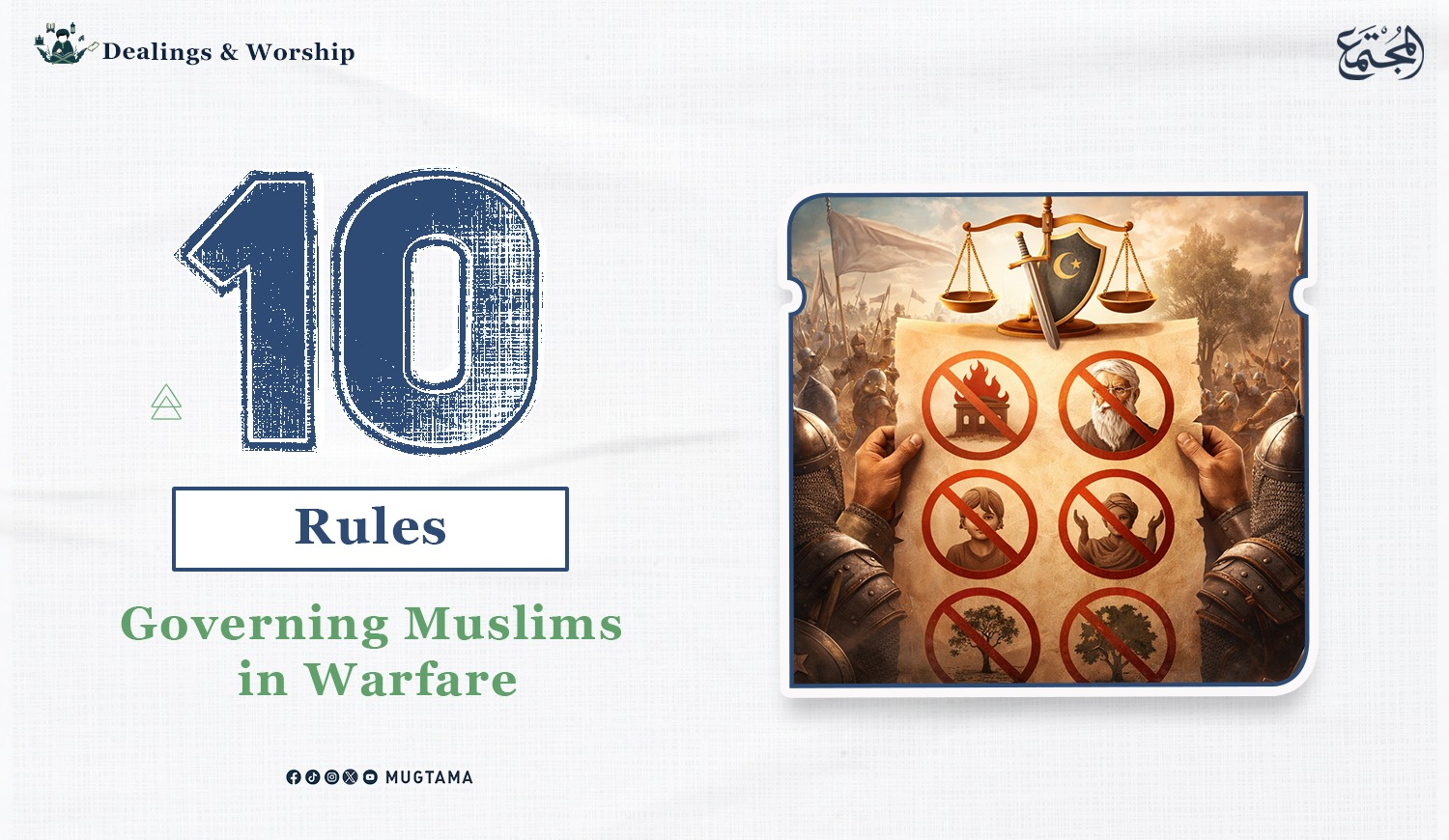
Islamic Shari`ah
is distinguished by its profound concern for establishing justice
and safeguarding human dignity. It has presented a practical model of
compassion toward the vulnerable—women, children, and the elderly—and has
encouraged tolerance and
social solidarity even in the most difficult circumstances.
While
man-made laws often shine in times of peace yet reveal their harshness when
wars intensify, Islam restrained the impulse for revenge through
strict ethical guidelines.
In light
of the wars the world witnesses today—wars that often fail to distinguish
between civilians and combatants—the moral miracle of Islam becomes strikingly
clear. This reality was described by Dr. Mustafa As-Siba`i, who said: “I swear
that if history did not speak truthfully about this unique miracle in the
history of military ethics, leaving no room for doubt, I would have said it was
merely a myth or a legend with no shadow on earth.”
Fundamental Principles of War in Islam
Islam
established ten fundamental principles that transform war from a tool of destruction into a
means of establishing justice:
1. The Purpose of War in
Islam: Removing Oppression, Not Seeking Dominance
Fighting
in Islam is neither aggression nor a quest for worldly gains. Rather, it is a
means of repelling injustice.
Allah says, {Fight in the cause of Allah ˹only˺ against those who wage war against you,
but do not exceed the limits.} [Al-Baqarah 2:190]
The
highest objective is to elevate the word of Allah and support the oppressed.
The Prophet (peace be upon him) said: “The one who
fights for Allah’s word to become Superior, is striving in Allah’s Cause.”
(Narrated by Al-Bukhari and Muslim)
2. Maintaining Humanity
Even in Warfare
Islam
strictly prohibits mutilating bodies or seeking revenge after victory. It
emphasizes that warfare must remain framed by mercy, even on the battlefield.
3. Protecting Non-Combatants
in Islamic Warfare
Islam
forbids harming those who do not participate in war, foremost among them children, women, and monks. The
Prophet (peace
be upon him) said: “Do not kill a
decrepit old man, or a young infant, or a woman.” (Narrated by Abu
Dawud)
He also
instructed military leaders: “Do not kill a
child.” (Narrated by Muslim)
4. Environmental Protection
During War
Centuries
before modern international laws, Islam introduced principles for protecting the environment during conflict.
This is
reflected in the famous instructions of Abu Bakr As-Siddiq to his armies: “Do
not betray, do not steal from the spoils, do not act treacherously, do not
mutilate, do not kill a young child, an elderly man, or a woman. Do not cut
down palm trees or burn them, do not cut down fruitful trees, and do not
slaughter sheep, cattle, or camels except for food…”
5. Absolute Faithfulness to
Treaties and Agreements
At a time
when betrayal is often used as a military tactic, Islam strongly emphasizes fulfilling covenants.
Allah says, {Honour ˹your˺ pledges, for you will surely be
accountable for them.} [Al-Isra’ 17:34]
The
Prophet (peace
be upon him) warned severely against treachery: “If a man trusts someone with his life then he kills him,
I am free from the killer—even if the one killed was a disbeliever.” (Narrated by Al-Bukhari)
6. Humane Treatment of
Prisoners of War
Islamic Shari`ah
made kindness toward prisoners an act
of worship for which a person hopes for reward. Allah says, {They give food—despite their desire for it—to the poor,
the orphan, and the captive.} [Al-Insan 76:8]
Dr. Ali
As-Sallabi mentions how such noble treatment influenced some prominent
prisoners—such as Abu Aziz and As-Sa’ib Ibn `Ubayd—who embraced Islam after
witnessing the Prophet’s refined conduct.
7. Rejecting Revenge and
Promoting Forgiveness
This
principle was vividly demonstrated during the Conquest of Makkah,
when the Prophet (peace be upon him)
presented a historic model of forgiveness toward
those who had expelled and harmed him. He granted them safety, declaring: “Who enters the house of Abu Sufyan will be safe, who
lays down arms will be safe, who locks his door will be safe.” (Narrated
by Muslim)
8. Inclining Toward Peace
Whenever Possible
Peace is the
original principle, while war remains a necessity limited by circumstances.
Allah says, {If the enemy is inclined towards
peace, make peace with them. And put your trust in Allah.} [Al-Anfal 8:61]
Interpreters
note that the command to accept peace remains valid even if deception by the
enemy is possible—demonstrating Islam’s deep preference for peace.
9. Justice Even Toward
Enemies
In Islam,
justice does not
disappear in the presence of hostility. Allah says, {Do
not let the hatred of a people lead you to injustice. Be just! That is closer
to righteousness.} [Al-Ma’idah 5:8]
10.
Establishing Justice as the Ultimate
Goal
War in
the Islamic worldview is a temporary and exceptional stage, whose sole purpose
is to restore moral balance and establish justice
among people. It is never an objective in itself.
For Further Reading:
- The New Face of War on Islam
- Fiqh al Jihad Book By Dr. Yusuf al-Qaradawi (1-3)
- Islam Creates World Peace (1) Equality for All People
-------------------------------------------------------------