







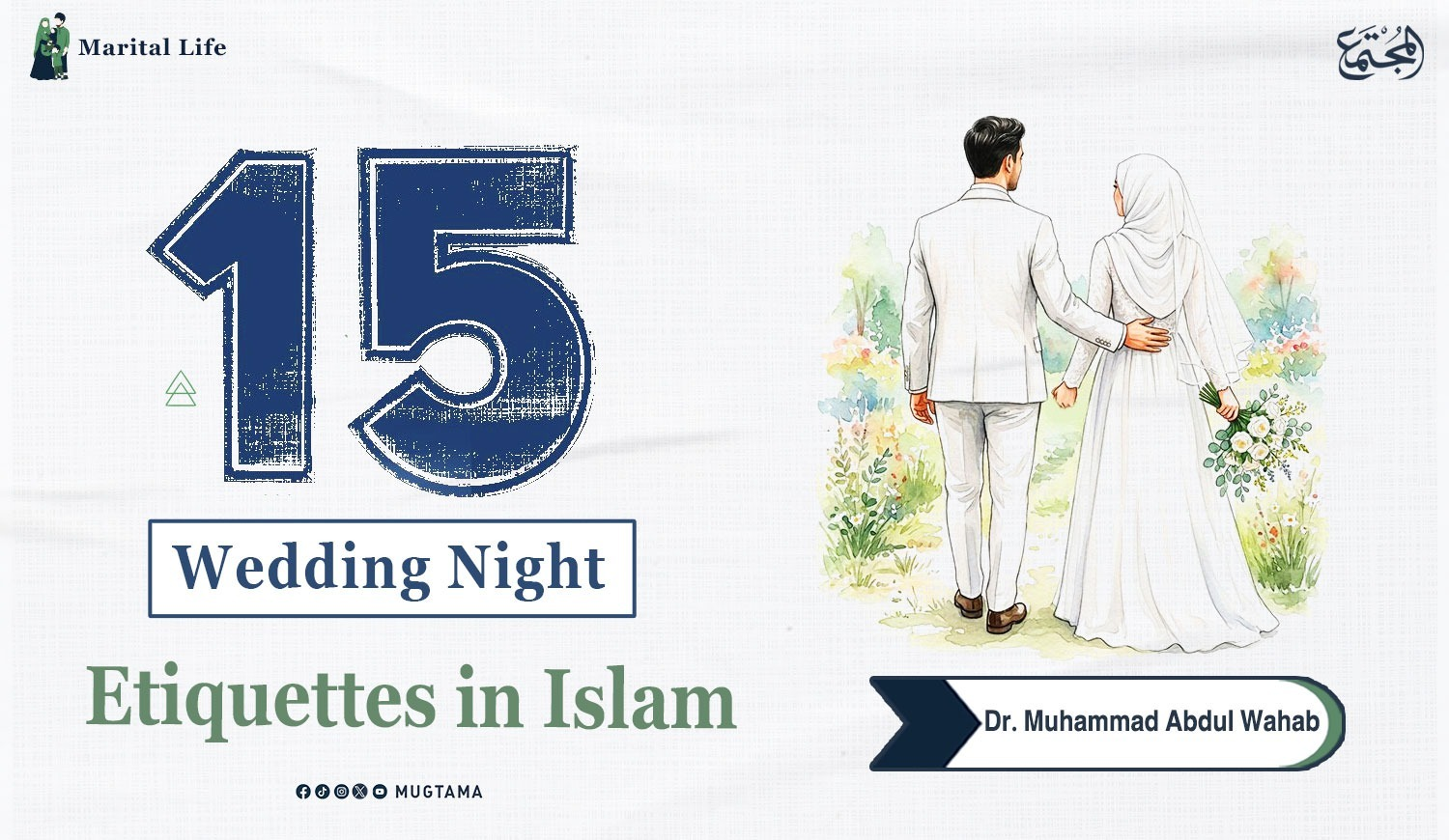
15 Wedding Night Etiquettes in Islam
The
wedding night is a night filled with affection, where meanings of gentleness,
intimacy, and tranquility blossom. On this night, the husband extends threads
of love to his wife’s heart, easing her anxiety about new beginnings and
replacing it with comfort and calm. Their souls grow familiar
with one another, and her heart finds safety and harmony with him.
Sunnahs and Etiquettes of the Wedding Night
These are
a number of Prophetic practices and noble etiquettes that every couple
embarking on this blessed life should keep in mind, so that their beginning is
filled with goodness and connected to blessings:
1. Sincere Intentions in
Marriage
Both the
husband and wife should begin their marriage with sincere and noble intentions—seeking chastity, protecting themselves, helping one
another in obedience to God, staying away from what is forbidden, and hoping
for righteous children who uphold faith and values.
Actions
are blessed through intentions, and with sincerity, the doors of success are
opened. Abu Hurairah narrated that the Prophet (peace be upon him) said: “There are three for whom it is a right upon Allah to
help him: The Mujahid in the cause of Allah, the Mukatab who intends to fulfill
(the Kitabah), and the one getting married who intends chastity.” (Narrated
by At-Tirmidhi)
2. Supplication Upon
Entering the Home
When the
couple enters their home and settles in, it is recommended that the husband
place his hand gently on the front of his wife’s head and say: “Allāhumma innī as'aluka khayrahā wa khayra mā jabaltahā
`alayh, wa a`ūdhu bika min sharrihā wa sharri mā jabaltahā `alayh. When any of
you marries a woman or purchases a maid-servant then let him say: O Allah, I
ask You for the goodness of her, and the goodness upon which You have created
her, and I seek refuge in You from the evil of her, and from the evil upon
which You have created her. If you purchase a camel then take hold of the top
of its hump and say the same.” (Narrated by Abu Dawud and Ibn Majah)
3. Gentle Kindness at the
First Meeting
The first
meeting should be filled with gentleness and affection. Sharing a drink or
engaging in kind conversation helps bring hearts closer, removes discomfort,
and lays the foundation for intimacy.
A kind
word and a gentle attitude are keys to hearts. The Prophet (peace be upon him)
once drank from a cup of milk and then offered it to his wife `A’ishah (may
Allah be pleased with her).
4. Praying Together at the
Beginning of Marriage
It is
beautiful for the couple to begin their life by standing together in prayer,
asking Allah for blessings in their marriage and that He unites them upon
goodness and righteousness.
Some of
the early companions advised that the husband lead his wife in two units of
prayer. Ibn Mas`ud told Abu Hariz: “Ask your wife to pray two units of
prayer with you and say, ‘O God, bless me in my wife and bless her in me. O
God, unite us in goodness and separate us in goodness.’” (Narrated by Ibn Abi
Ad-Dunia)
5. Adorning Oneself for One
Another
Each
spouse should beautify themselves for the other, outwardly and inwardly, within
what is permissible. Good appearance reflects good companionship and mutual
affection.
Just as a
wife seeks to please her husband, the husband should also prepare himself for his
wife. Allah says, {Women have rights similar to
those of men equitably.} [Al-Baqarah 2:228]
However,
this beautification must remain within what is permissible. It is not allowed
for the husband to shave his beard, pluck his eyebrows, or wear silk. Likewise,
the wife should not beautify herself for him through prohibited means such as
plucking the eyebrows, attaching hair extensions, tattooing, or any other
practices that are forbidden by religious law.
6. Using Fragrance Before
Intimacy
Fragrance
is an adornment of the body and a source of comfort for the soul. It enhances
affection and brings joy, as people are naturally drawn to pleasant scents just
as they are to good character.
It was
reported in Al-Bukhari and Muslim that `A’ishah said: “I used to put perfume on the Messenger of Allah (peace be upon
him) and he would go around
to all his wives, then enter Ihram in the morning with the smell of perfume
coming from him.”
7. Emotional Preparation
Before Intimacy
The
husband should begin with gentleness, playfulness, and affection before
intimacy so that both partners are emotionally and physically prepared. The
relationship should be based on harmony, not haste, and kindness, not harm—so
that both partners attain satisfaction.
8. Supplication Before
Intimacy
It is
part of devotion to begin this moment with remembrance of Allah by saying, “In the name of God. O God, keep us away from the devil
and keep the devil away from what Thou hast provided us,” should it be ordained
that a child be born to them thereby, no devil will ever harm it.” (Narrated
by Al-Bukhari)
9. Permissible Intimacy in
Marriage
The
foundation of marital relations is permissibility within what God has allowed,
while avoiding what He has forbidden.
Intimacy
is only permissible in the natural place intended for reproduction, protecting
the sound innate nature.
Jabir
declared that the Jews used to say: “When a man
has intercourse with his wife through the vagina, but being on her back, the
child will have a squint,” so the verse came down, {Your wives are a tilth to
you, so come to your tilth however you will} [Al-Baqarah 2:223] (Narrated by Al-Bukhari and Muslim)
On the
wedding night, especially when both are new to intimacy, the husband should act
gently and avoid anything that may harm his wife.
10.
Considering the Wife’s Needs
The
relationship should not be limited to fulfilling the husband’s needs. The
wife’s emotional and physical needs must also be considered to achieve fairness and
compassion. The husband should not rush away after fulfilling his need but
should remain until his wife is also satisfied.
11.
Prohibition of Intercourse During
Menstruation
Intercourse
during menstruation is prohibited with consensus of scholars, as Allah SWT says,
{So keep away, and do not have intercourse with
your wives during their monthly cycles until they are purified.} [Al-Baqarah
2:222]
Abu
Hurairah reported that the Prophet (peace be upon him) said: “If anyone has intercourse with a woman who is
menstruating, or uses preposterous venery with a woman, or visits a kahin, he
has disbelieved in what has been sent down to Muhammad.” (Narrated by At-Tirmidhi and Abu Dawud)
12.
Prohibition of Anal Intercourse
This act
is forbidden as it goes against human innate nature and the limits set by
divine law. Abu Hurairah reported that the Prophet (peace be upon him) said: “He who has intercourse with a woman through her anus is
accursed.” (Narrated by Abu Dawud)
13.
Protecting Marital Privacy
One of
the trusts of marriage is to preserve its secrets
and not disclose private matters. Safeguarding intimacy is a sign of dignity
and sincerity.
Abu Sa`id
Al-Khudri reported that the Prophet (peace be upon him) said: “The worst of people in position before Allah on the Day
of Resurrection is the man who has intercourse with his wife, and she with him,
and then spreads her secrets.” (Narrated by Muslim)
14.
Covering or Uncovering During Intimacy
Both are
permissible actions with no blame, as long as the purpose of intimacy is
fulfilled. As for the narration, “When anyone of
you has intercourse with his wife, let him cover himself and not be naked liked
donkeys,” it was reported by Al-Bayhaqi in As-Sunan Al-Kubra and
others, with a weak chain of transmission.
15.
Ritual Bath After Intimacy
After
intercourse, ritual bathing is required—even if ejaculation does not occur—to
maintain purity and readiness for worship, so that Muslim’s life stays pure and
clean.
Abu
Hurairah reported that the Prophet (peace be upon him) said: “If one lies on his wife and compresses her, washing is
necessary, even if there is no orgasm.” (Narrated by Muslim)
Muslim
also narrated: “When anyone sits amidst four
parts (of the woman) and the circumcised parts touch each other a bath becomes
obligatory.”
Thus,
married life begins with the light of prophetic guidance and the fragrance of
noble etiquette—making it closer to tranquility and more likely to sustain love
and mercy.
For Further Reading:
- 5 Key Islamic Principles for the First Year of Marriage
- 10 Tips to Bring Positive Energy Between Spouses
- How Islam Turns a Mother’s Daily Responsibilities into Worship
-------------------------------------------------------------