






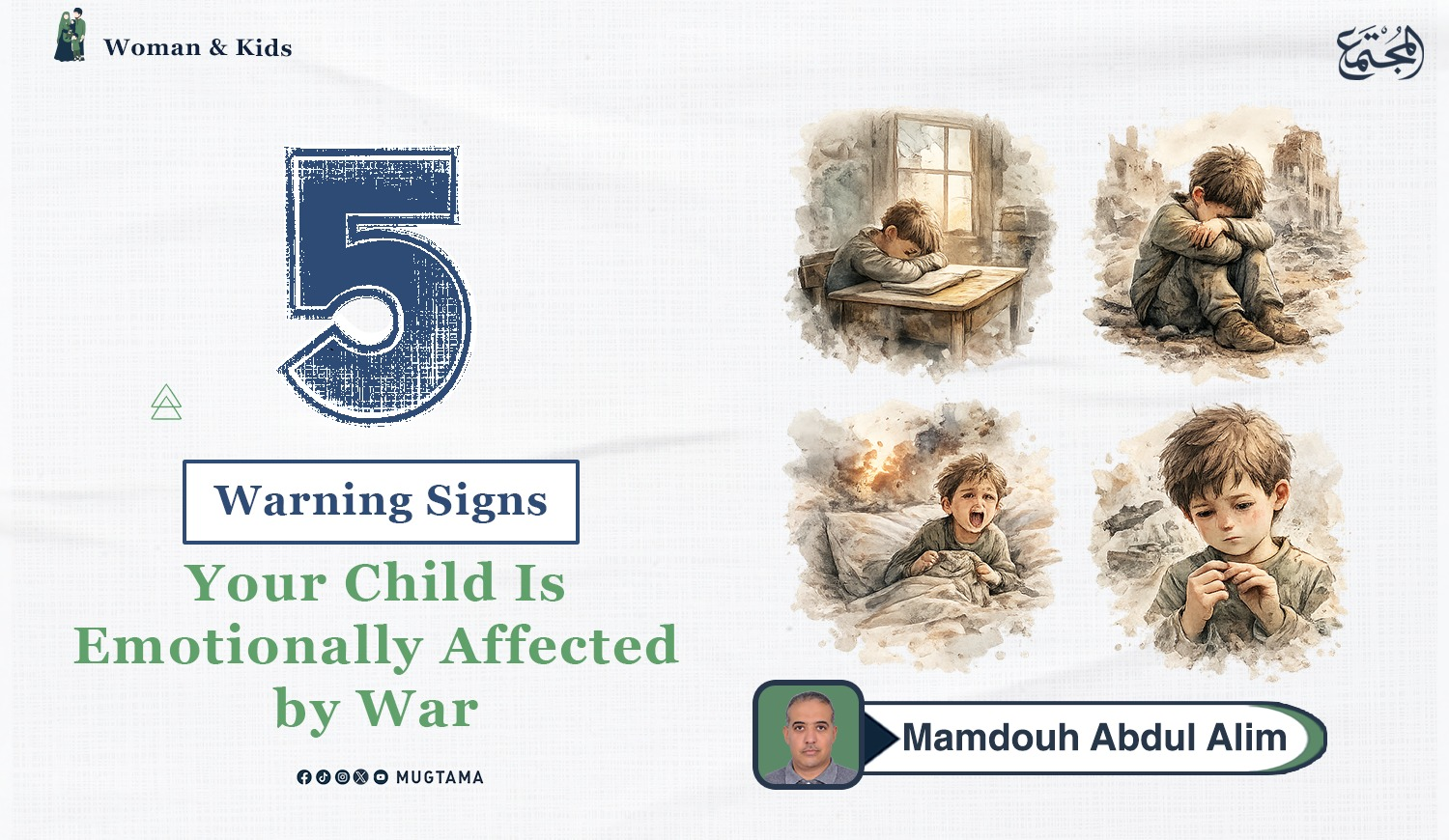
5 Warning Signs Your Child Is Emotionally Affected by War

Everything
seemed normal—play, laughter, and cheerful conversations. But for a moment, his
eyes froze on a scene on the television screen—a scene he had never witnessed
before. It was something he had only seen in cartoons or read about in
fictional stories, but now he was watching it unfold as a real-life event:
explosions, drones, destruction, wounded bodies… scenes taking place in his own
country, which only moments ago had been immersed in safety and security.
At the
end of the day, he went to bed—but not as he once was. Something was missing.
He began asking for things he could not name—longing for feelings that had once
been present but had now disappeared. He was now tasting the burdens of adults
while still a child!
Silently,
without noise, new emotions begin to invade the child’s world. They creep into
his heart, mind, and soul, seeking to settle within him. At that moment, our role as parents
is not to isolate the child from reality, but to build a strong, aware
child—one who can adapt to the current reality without psychological fragility.
This
leads us to a crucial question:
How Wars Disrupt a Child’s Emotional
Development
1. Premature Emotional
Maturity in Children
During
times of war, children are unfortunately exposed to intense human emotions that
exceed their age and cognitive capacity. They experience overwhelming feelings
such as grief, fear, pain, panic, loss, separation, and distress.
These
emotions grow even heavier when they accumulate within a single child, who
experiences them without fully understanding their meaning or context. War does
not merely teach children information—it forces them into deep emotional
experiences without the psychological tools needed to process them.
As a
result, what appears to be “emotional maturity” becomes, in reality, a heavy
psychological burden—one that is largely internal and difficult to comprehend.
2. The Rise of Existential
Questions in Children
It is
natural for children to ask simple questions appropriate to their age. These
questions should be answered in ways that align with their level of
understanding.
However,
war pushes children toward profound existential questions—questions that often
belong to adults, such as:
- Where is Allah in
these wars?
- Did Allah create evil?
- Is Allah pleased with
this bloodshed?
- Why are Muslims not granted victory?
- Why does dominance
often seem to favor others? (1)
These
questions are difficult—not only to ask, but even more so to answer. If
answered incorrectly or in ways that do not suit the child’s age and
understanding, we may unintentionally harm rather than help.
Thus, it
is crucial not to ignore these questions—and equally important to answer them
with wisdom, logic, and age-appropriate understanding.
3. The Loss of Childhood
Innocence
In times
of war, children become torn between two conflicting worlds:
- A world suited to
their age—play, joy, and innocence
- And another filled
with destruction, violence, and fear
Gradually,
spontaneity begins to fade. The child no longer fully enjoys their natural innocence.
Instead, they begin to feel older than their years, living experiences they
never imagined.
This
shift becomes even more harmful when parents are unaware of the psychological
stage their child is going through and fail to respond with awareness and care.
4. Developing a Distorted
View of the World
Children’s
innocence naturally leads them to see the world as safe, beautiful, and
trustworthy—almost like a piece of paradise.
However,
war reshapes this perception. It replaces light with darkness, safety with
fear, and trust with uncertainty. The child may begin to view the world through
a bleak and frightening lens.
If not
properly addressed, these experiences can lead to long-term psychological
disturbances that may persist throughout life—especially when parents fail to
provide emotional guidance during crises.
5. Emotional Instability
and Internal Conflict
During
war, children often experience emotional instability. A child who is highly
sensitive and emotionally expressive may suddenly become emotionally numb or
excessively hardened as a defense mechanism.
At other
times, the child may experience overwhelming fear—fear of the present, fear
that consumes their entire being. In contrast, some children may pretend to be
brave, masking their fear because they are unable to reconcile their emotions
with the reality they are witnessing.
The Role of Parents in Protecting
Children During War
From all
of this, it becomes clear that parents carry a heavy responsibility and a
profound role. They are the central force in guiding and correcting the
emotional compass of their children.
They
must:
- Contain their
children’s emotions with awareness and care
- Guide them toward
healthy emotional understanding
- Choose the most
appropriate methods to address fear, anxiety, and panic
- Help children
interpret reality in a balanced way—not exaggerated or overwhelming
Excessive
exposure or exaggerated reactions can destroy rather than build, fragment
rather than strengthen. It can leave deep emotional wounds that may never fully
heal.
Therefore,
swift and conscious action is necessary—to restore balance, protect emotional
well-being, and guide children safely through the storms of reality.
For Further Reading:
-------------------------------------------------------------
Footnotes:
- This question may be
raised by someone who does not know his glorious history. Unfortunately, he was
born in later times and has neither seen with his eyes nor heard with his ears
anything but defeat, humiliation, and disgrace for our great Ummah.