







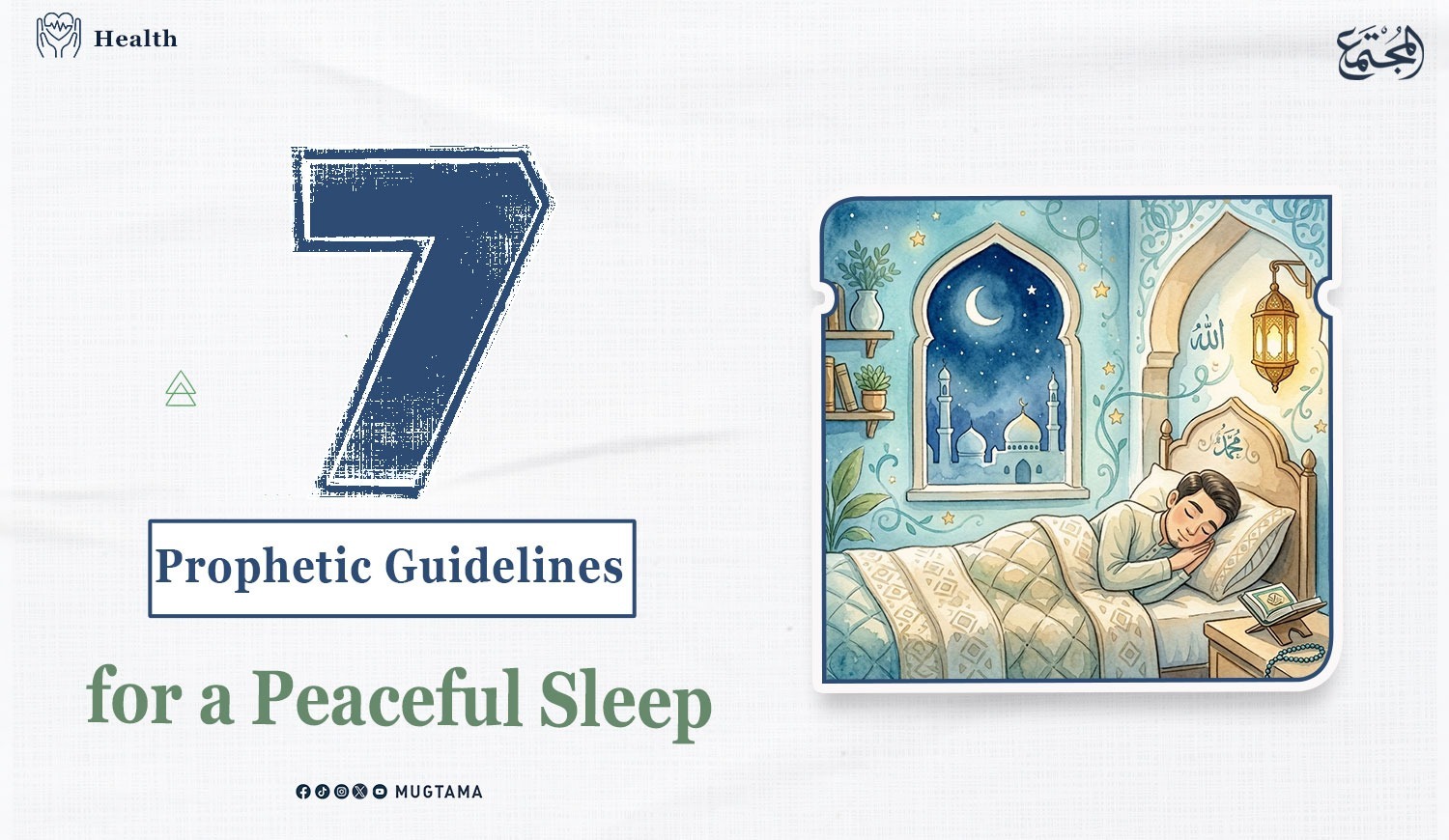
7 Prophetic Guidelines for a Peaceful Sleep
Sleep habits
vary from one person to another, and some individuals may adopt unusual
practices, such as sleeping beside cats and dogs, falling asleep to music, or
sleeping without covers—all of which can ultimately affect the quality of sleep.
Experts warn
against allowing cats and dogs in the bed, due to the risk of scratches or
bites, or even the danger of suffocation if the animal lies over the sleeper’s
face. They also caution against eating heavy meals before bedtime, as well as
engaging with stimulants and distractions such as phones, television, and
electronic games.
Specialists
emphasize the importance of deep sleep, during which blood flow to the muscles
increases, the body undergoes repair, tissues grow, and essential hormones for
growth and development are released.
But have you
ever asked yourself: how did the Prophet (peace be upon him) sleep? And how can
you achieve high-quality sleep that grants you full relaxation and restores
your energy and vitality?
Among the
Prophetic etiquettes of sleep:
First: Sleeping early and avoiding staying up late. It is
narrated in Sahih Al-Bukhari from Abu Barzah that the Messenger of Allah (peace
be upon him) disliked sleeping before the `Isha prayer and engaging in
conversation afterward.
Second: Performing ablution (wudu) before sleep, as the
Prophet (peace be upon him) said: “When you go to your bed, perform ablution as you
do for prayer...” (Al-Bukhari and Muslim).
Third: Cleaning and dusting the bed, following the saying of
the Prophet (peace be upon him): “When one of you goes to his bed, let him dust it
with the inside of his garment, for he does not know what has come onto it
after him.” (Al-Bukhari).
Fourth: Lying on the right side, as this was the practice of
the Prophet (peace be upon him), and avoiding sleeping on the stomach—the way
of Shaytan—or other positions that are unhealthy or unsuitable for the spine.
Fifth: Maintaining the remembrances (adhkar) of sleep,
supplication, and seeking forgiveness; reciting Surah Al-Ikhlas and Al-Mu`awwidhatayn,
or whatever one knows of the Quran; seeking Allah’s forgiveness for any
shortcomings during the day; and asking Allah for pardon and well-being.
The Prophet
(peace be upon him) would, when going to bed each night, gather his palms, blow
lightly into them, recite: “Say, He is God, One,” “Say, I seek refuge in the
Lord of the dawn,” and “Say, I seek refuge in the Lord of men,” he would wipe
as much of his body as he could with his hands. (Al-Bukhari).
Sixth: Waking up in the last third of the night for prayer
and night worship. In the two Sahihs, a man was mentioned to the Prophet (peace
be upon him) who slept through the night until morning, and he said: “That is a man
in whose ears Shaytan has urinated.”
Seventh: Closing doors and turning off electricity, gas, and
the like before sleeping. In the two Sahihs, from Abdullah ibn Umar, the
Prophet (peace be upon him) said: “Do not leave a fire burning in your houses while
you are asleep.” (Al-Bukhari).
Jabir ibn
Abdullah reported that he heard the Messenger of Allah (peace be upon him) say:
“Cover
the vessels and tie the waterskin, for there is a night in a year when
pestilence descends, and it does not pass an uncovered vessel or an untied
waterskin but some of that pestilence descending into it.” (Muslim).
Read Also:
-
5 Habits for a Healthier Life from Prophet’s ﷺ Sunnah
-
Sunnah's Role in Islamic Revival
-------------------------------------------------------------