






7 Zionist Reasons for Obstructing Gazan Movement Through the Rafah Crossing
The
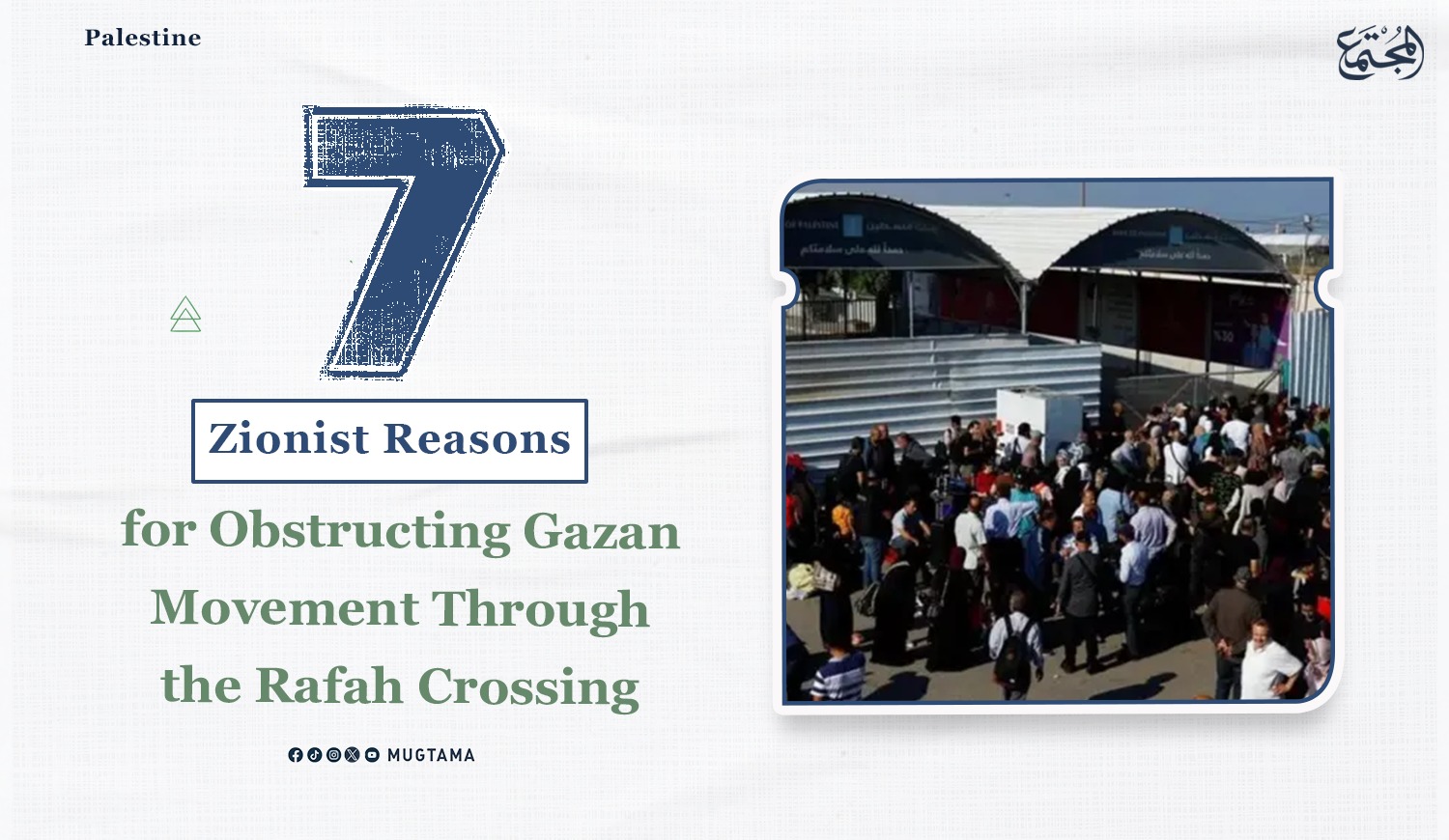
obstruction of Palestinians’ travel and return through the Rafah crossing is no
longer a transient security measure; rather, it has evolved into a systematic
Zionist policy driven by a mindset of control and blackmail.
The
crossing, which is supposed to be a humanitarian lifeline, has become a tool of
political leverage used to reshape the reality in the Gaza Strip, dictate the
fate of its inhabitants, and subordinate their humanitarian needs to military
and regional calculations.
The
following are the most prominent reasons behind this policy, accompanied by
examples illustrating their implementation on the ground:
1. Political Pressure on Gaza and the Resistance
The occupying state uses the crossings as a
direct lever of pressure to weaken the resistance and impose political and
security conditions in any truce agreement or future arrangements, effectively
turning humanitarian needs into bargaining chips.
2. Perpetuating Humanitarian and Political Instability
The
occupation authorities intentionally obstruct the return of Palestinians to
perpetuate the humanitarian crisis in Gaza, aiming to wear down Gazan society,
deplete its resilience, and push it toward mounting internal pressures.
3. Preventing the Reorganization of Gazan Society and
Institutions
The
return of thousands of Palestinians represents a natural step toward
revitalizing social, economic, and institutional life. This stands in direct
contradiction to the occupation’s objective of keeping the Strip in a state of
paralysis and long-term chaos.
4. Baseless Security Pretexts
The
occupying state markets the obstruction of the crossing under the guise of
'security considerations,' claiming it prevents the entry of individuals or
materials that pose a threat. However, the fact that the vast majority of
returnees are civilians exposes the purely political nature of this pretext.
5. Utilizing the Crossing as a Bargaining Chip
The occupying state insists on linking the
reopening of the Rafah crossing to other negotiation files—such as the prisoner
issue, the disarmament of the resistance, and post-war arrangements—in an
attempt to extract strategic gains at the expense of human suffering.
6. Pressuring Egypt and International Mediators
The
obstruction of the crossing serves as an indirect message of pressure on Egypt
and international mediators, intended to push them toward adopting 'Israeli'
conditions within negotiation tracks while burdening them with additional
humanitarian and political costs.
7. Depopulating Gaza and Intimidating Those Seeking to Return
The
obstruction of return aligns with growing Palestinian fears of a policy aimed
at gradually reducing the population of the Gaza Strip and imposing a new
demographic reality, by intimidating those who leave and preventing them from
returning.
In
conclusion, it is evident that transforming the Rafah crossing into a tool for
political bargaining is, but one part of a broader strategy aimed at 'searing
the consciousness' of Palestinian society and forcing it into submission by
depriving it of the most fundamental right to freedom of movement.
The
persistence of this systematic Zionist policy transcends the boundaries of
'security measures,' effectively amounting to a sentence of civil death for the
Gaza Strip. This places a historic responsibility upon the international
community to wrest the humanitarian dossier from the clutches of political
blackmail and to guarantee freedom of movement as an inalienable,
non-negotiable right.
You may
also like:
Eight Zionist Drivers of Gaza’s Selective Blockade