









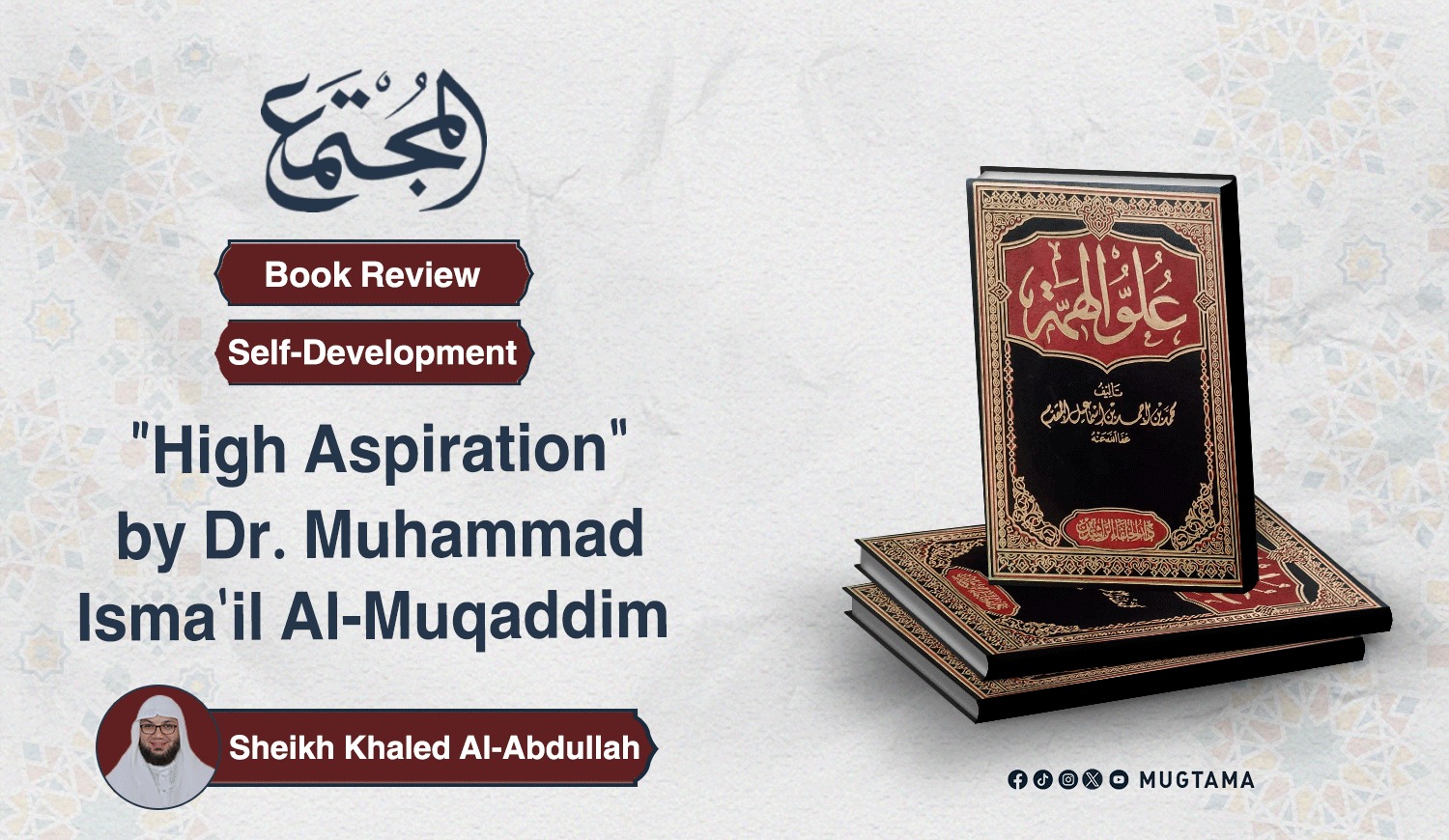
Book Review: “High Aspiration” by Dr. Muhammad Isma'il Al-Muqaddim
Chapter One: The Definition and Reality of Aspiration (Himmah)
This chapter
focuses on the foundational and conceptual dimension. The author begins by
defining himmah linguistically and technically, explaining that it is
the origin of human will. He also examines the differences in levels of
aspiration among people, clarifying that high aspiration means regarding
anything short of the ultimate goals in noble matters as insignificant.
The author also
discusses the relationship between aspiration and civilization, explaining that
the aspiration of the individual is the primary driving force behind every
human achievement.
Furthermore, he
distinguishes between nobility of the soul and arrogance, and between
self-respect and vanity, emphasizing that a person of high aspiration
recognizes his own worth and therefore protects himself from lowly conduct.
Chapter Two: The Characteristics of a Person of Great Aspiration
In this
chapter, the author explains the psychological and behavioral qualities that
distinguish a person of high aspiration. Among the most important of these
qualities is that a person of high aspiration is self-made rather than
ancestry-made—meaning that they rely on themselves and take pride in their
own accomplishments rather than the achievements of their forefathers.
Other
characteristics include:
- Seriousness in dealing with
life and rising above trivial matters.
- The ability to turn hardships
into opportunities.
- Refusing to accept mediocrity
and remaining restless until reaching the highest level in one’s field or
in worship.
- Possessing humility and not
becoming deceived by one’s achievements.
Chapter Three: Encouragement Toward High Aspiration in the Quran and
Sunnah
This chapter
represents the scriptural foundation of the book. The author explores the
Quranic methods of inspiring determination, such as the commands to hasten,
compete, and race toward good deeds, as well as the praise given to the
resolute messengers.
He also cites a
number of prophetic traditions that encourage striving for lofty matters and
condemn trivial pursuits, such as the saying of the Prophet (peace
be upon him): “Indeed Allah loves those of elevated character and
dislikes those of inferior ˹character˺.”
The author
concludes that the Companions (may Allah be pleased with them) were the people
of the highest aspiration precisely because of this prophetic guidance.
Chapter Four: The Fields of High Aspiration
This chapter
contains detailed sections illustrating the practical manifestation of high
aspiration in the lives of the righteous predecessors.
- Section One: High Aspiration in
Seeking Knowledge
It highlights their careful use of time, their long journeys for the sake of a single hadith, their patience with hunger and poverty for the sake of learning, and their ability to read large volumes in only a few days. - Section Two: High Aspiration in
Worship and Uprightness
This section presents examples of their dedication to prayer, fasting, and night worship, showing that worship for them was a source of delight rather than a burden. - Section Three: High Aspiration
in the Search for Truth
The author presents historical examples such as Salman al-Farsi and Abu Dharr, along with modern seekers who sacrificed greatly in order to reach the true religion. - Section Four: High Aspiration
in Da`wah and Jihad
This section demonstrates the determination of the early generations in carrying the responsibility of the religion, spreading it across lands, and sacrificing their lives and wealth in the path of Allah.
Chapter Five: The State of the Ummah When Aspiration Declines
In this
chapter, Dr. Al-Muqaddim provides a precise diagnosis of the condition of the
Muslim Ummah when the aspirations of its individuals weaken. He describes the
manifestations of declining ambition that have led to dependency on others,
acceptance of civilizational subordination, and the spread of despair and
lethargy.
He also links
the fall of aspiration with the loss of lands and sacred places, considering
the disease of wahn—love of worldly life and hatred of death—as the
natural consequence of declining aspiration.
Chapter Six: Causes of the Decline of Aspiration
In this
chapter, the author analyzes the causes that lead to weak determination,
including:
- A discouraging environment and
a demotivating society.
- Ignorance and reliance on false
hopes.
- Procrastination and following
personal desires.
- Becoming preoccupied with
worldly attractions at the expense of the higher aims of the Hereafter.
- The absence of righteous role
models in the lives of the young.
Chapter Seven: Means of Elevating Aspiration
The author
presents a practical path for remedying this problem, including:
- Knowledge and insight: Knowledge raises one’s aspiration above the
depths of blind imitation.
- Keeping the company of people
of high aspiration: For
companionship has a powerful influence.
- Reading the biographies of
great individuals: Stories
are among the soldiers of Allah that strengthen hearts.
- Renewing faith in the
Hereafter: Remembering death, the grave,
and Paradise drives away laziness.
- Supplication: Turning to Allah and asking Him for noble and
lofty goals.
Chapter Eight: The Impact of High Aspiration on Reforming the Individual
and the Ummah
The author
concludes the book by explaining its ultimate message: high aspiration is the
key to restoring dignity. He clarifies that the reform of society begins with
the reform of individuals, and the reform of individuals begins with elevating
their aspirations.
History, he
argues, is shaped only by people of powerful determination. He ends with a
final message to every Muslim: to become the awaited reformer who changes the
condition of the Ummah through the elevation of his or her aspiration.
Read Also:
-
10 Strategies for Effective Self-Development
-
5 Paths for Individual Reform
-
Contemporary Reading of Self-Development in the Quran
-------------------------------------------------------------