









The News-Obsessed Husband
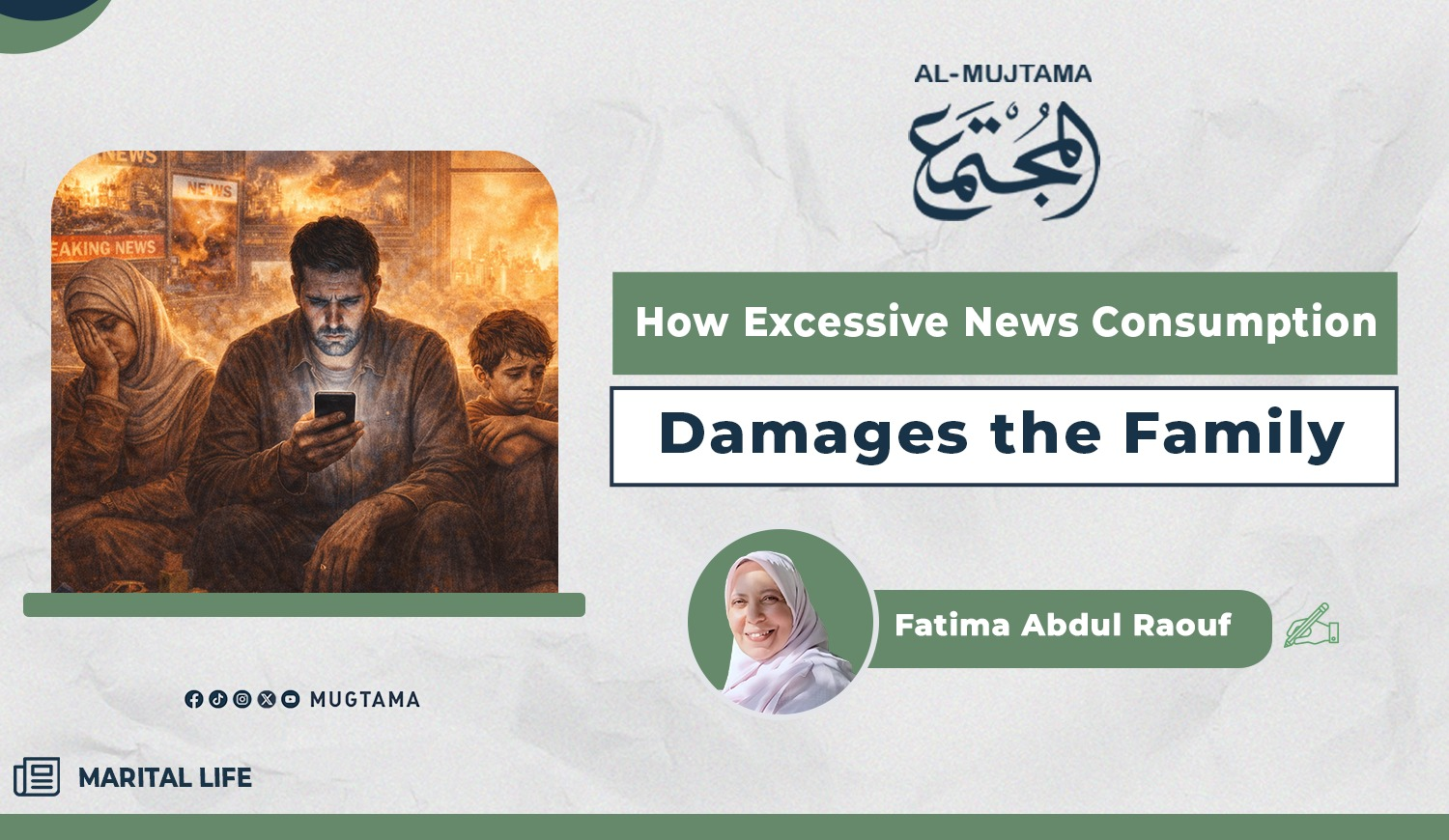
How Excessive News Consumption Damages the Family
We
gathered in our large family home, as was our custom on the morning of Eid. The
spacious hall was filled with the men’s sitting area, the women’s gathering,
and children playing everywhere. Yet it was an Eid weighed down with fear—it
was the Eid that followed the tragedy of the invasion of Kuwait, as the second Gulf
War loomed at the doors.
That day,
I could not feel the joy of Eid as I saw my father and uncles so deeply
angered. Instead of warm words and heartfelt greetings, political debates
erupted. Anxiety overshadowed everyone, and its waves reached us—the children.
From time
to time, one would say he had read certain news, another would say he had heard
something else, and some spoke about end-times hadiths, applying them to the
unfolding events. That day, politics stole from me the joy of Eid—and the safe
warmth that once sheltered us in the family home was replaced by anxiety,
tension, anger, and endless debate.
From Limited News to Constant Exposure
Time
moved on. Instead of one or two TV channels, brief news bulletins, simple
images, and delayed newspapers, we now live in an era of breaking news that
follows us second by second—making us part of the event, not just observers.
Even when
the television is turned off, digital notifications continue relentlessly,
delivering updates. Social media has become flooded with news, analyses,
rumors, and polarization.
Some
media studies indicate that the average time spent following news in normal
circumstances ranges from one to two hours daily. However, during crises, this
rises to three to five hours a day.
In the
Arab context, men tend to follow analysis more deeply and continuously, while women are more
concerned with how crises directly affect daily life—such as rising prices or
scarcity of goods.
Men, on
the other hand, often focus on the broader dimensions and outcomes of conflict,
perhaps in an attempt to feel a sense of control through information—or due to
social pressure, fearing being perceived as uninformed.
The
result? High levels of anxiety, fear, and tension. Studies suggest that 70% of
adults suffer from stress due to excessive news consumption.
How Constant News Consumption Impacts
Mental Health and Family Life
Disturbing
news does not pass lightly through the mind. It places the brain in a constant
state of alert, as the nervous system shifts into a “danger response mode.”
This
continuous state of alertness weakens concentration, drains psychological
energy, and inevitably impacts the home environment.
A man
deeply immersed in tracking every detail of the news may fail to notice that he
is neglecting his inner front—his home, his wife, and his children—those whom
he is responsible for protecting and caring for.
News Fatigue
One of
the most significant consequences within the home of a man consumed by news is
what is known as news fatigue.
Due to
prolonged exposure to conflict and continuous updates, he may experience:
1. Anxiety and Irritability
He
becomes tense and easily angered over minor issues. The once warm home turns
into a space filled with emotional explosions, as he loses control over his
reactions. Some may even suffer from sleep disorders, headaches, and muscle
tension.
2. Emotional Numbness and
Frustration
News
fatigue can lead to a state of deep frustration. Although he follows events
closely, he reacts passively. This frustration spreads into all areas of
life—even within the home—turning him into someone withdrawn, unresponsive,
silent, and neglectful of responsibilities.
At times,
this alternates between bursts of anger and periods of emotional coldness.
3. Mental Exhaustion
He
struggles to relax or clear his mind. This affects all aspects of life,
including his relationship with his wife, which may grow distant or emotionally
cold—impacting the entire household atmosphere.
4. Emotional Disconnection
from Children
A father
suffering from news fatigue loses the ability to listen to his children. When a
child seeks attention, he may be dismissed or ignored. As a result, the child
withdraws or escapes into screens in their own way.
How to Restore Warmth in the Home During
Times of Crisis
So what
is the solution?
How can
we restore warmth to our homes before it is consumed by the flood of news and
political anxiety? How can we protect our inner peace in times of fear? How can
we fulfill our responsibilities as caregivers?
1. Reconnecting with Faith
to Find Inner Peace
We must
reignite faith in our hearts
and renew our belief in divine decree—both its good and its difficult aspects.
What
happens in this turbulent world occurs by the wisdom of Allah. Trusting Him
brings immediate tranquility.
Constant
monitoring of events will not give us control—but believing that Allah sees,
hears, and knows everything will help us control our anxious emotions.
2. Calm and Constructive
Communication Within the Family
Dialogue rooted
in faith—free from blame, criticism, or accusation—is essential.
Conversations
should take place in calm environments, focusing on maintaining emotional
stability and prioritizing the safety of the home.
3. Regulating News
Consumption Without Total Avoidance
A wife
should not demand that her husband completely stop following the news—this is
unrealistic and unhealthy. Instead, she should encourage moderation and
balance.
She can
also participate in following the news, transforming it from a source of
division into a shared space for understanding—while ensuring discussions do
not turn into arguments.
4. Protecting Children’s
Psychological Safety
Children’s emotional security must be an absolute priority. They should not be
exposed to distressing news for extended periods, nor should anxious
conversations take place in front of them.
Body
language must remain calm—because children perceive emotions before they
understand words.
5. Rebuilding Family
Connection Away from Screens
Spending
warm family time—away from screens, news, and social media—is essential.
Simple
conversations, daily moments, and shared activities are among the most powerful
ways to restore warmth and connection in the home.
6. Providing Children with
a Faith-Based Understanding of Events
In an age
of open media exposure, children will inevitably encounter troubling
information.
Providing
them with a faith-based framework helps them understand events deeply and
process them with stability and reassurance.
7. Strengthening the Heart
Through Remembrance of Allah
Consistent
remembrance of Allah
brings peace to anxious hearts: {Those who believe
and whose hearts find comfort in the remembrance of Allah. Surely in the
remembrance of Allah do hearts find comfort.} [Ar-Ra`d 13:28]
We do not
control the course of events, nor the outcomes they bring. But we do control
how we respond to them.
We can
preserve the stability of our homes. We can keep them warm and secure—even when
conflict rages outside.
For Further Reading:
- Enjoy Raising Your Kids (3) Nurturing Faith, Character, and Excellence
- War Costs Squeeze Marriage Dreams
- Relying on Allah in Times of Crisis
-------------------------------------------------------------