





How Islam Protects Civilians in War
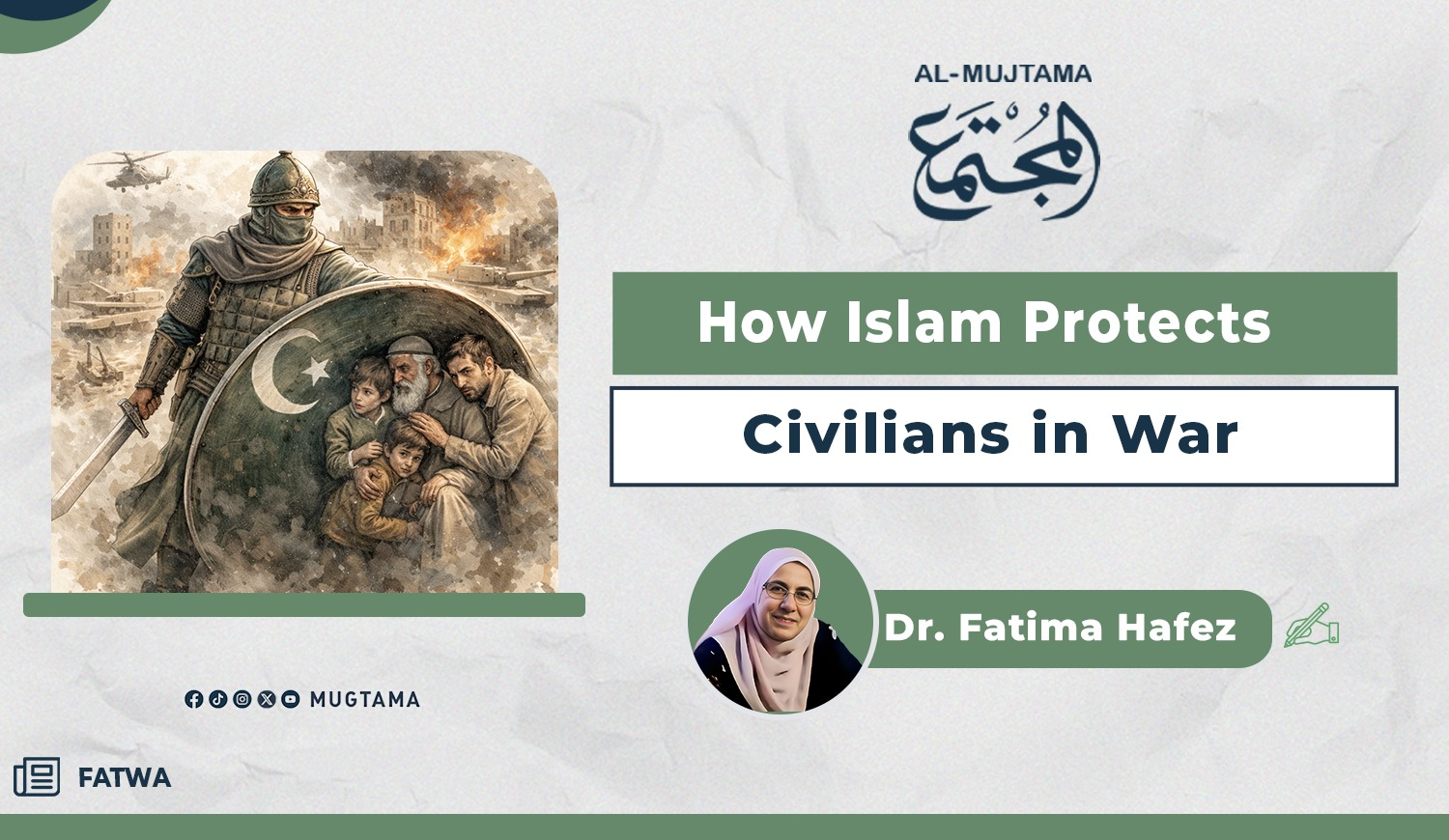
When
Islam legislated warfare,
it established for it principles and rules capable of regulating it so that it
does not turn into mere killing devoid of religious or ethical purpose. Among
these principles is the distinction between civilians and non-civilians.
Scholars have elaborated extensively on this concept, engaging in discussions
that even precede modern legal and human rights debates. So who is considered a
civilian in the Islamic legal framework? What categories fall under this
classification? And what rights do they possess?
Civilians in Islamic Law: Definition and
Categories
In
earlier times, the concept of “civilians” was used to refer to inhabitants of
cities as opposed to those living in deserts or rural areas. For this reason,
the term itself does not appear explicitly in classical jurisprudential texts.
Instead, scholars formulated alternative expressions such as: “non-combatants,”
“those who are not people of fighting,” “those who do not resist or fight,”
“those among disbelievers whose killing is not permissible,” or “those who have
not engaged in war.”
Scholars
provided detailed classifications of non-combatants whose killing is
prohibited. Abu Ghuddah summarizes their opinions and differences into two main
views:
- The first view: that
everyone who does not fight falls under those whose killing is prohibited
among disbelievers. This is the opinion of the majority of scholars.
- The
second view: that those whose killing is prohibited are specifically
women, children, and envoys. This is the opinion of the Shafi`i school,
based on the hadith: “I have been
commanded to fight against the people till they testify La ilaha illAllah
(There is no true god except Allah)..”
The
stronger opinion—according to `Imad Al-Ghamdi—is that of the majority, because
fighting is prescribed against those who fight, not merely due to disbelief. Based on this, scholars
detailed the categories of non-combatants, including:
Who Are Non-Combatants in Islam?
1. Women and Children
(Offspring)
There is
unanimous agreement among scholars that it is impermissible to kill women and
children. Ibn Abdul Barr stated that scholars are unanimously agreed on this
ruling. Allah says, {Fight in the cause of Allah ˹only˺ against those who wage war against you,
but do not exceed the limits.} [Al-Baqarah 2:190]
Ibn
Juzayy also affirmed: “Women and children are not to be killed by consensus.”
Scholars
explained that the prohibition is due to the fact that they are not combatants.
Human life is sacred and cannot be taken except with right. Some also added
that women and children are less entrenched in disbelief, and there remains
hope that they may accept Islam.
2. Religious Figures and
Monks
The
majority of scholars hold that monks and religious figures are not to be
killed, based on the Prophet’s (peace be upon him) statement: “Do not
kill the people of monasteries,” and the instruction of Abu Bakr to
Usamah: “You will pass by people
who have devoted themselves in monasteries, so leave them and what they have
devoted themselves to.”
Imam
Malik said: “The monk is not to be killed,” and he added that they should be
left with enough of their wealth to sustain themselves.
3. The Elderly and the
Chronically Ill
The
majority maintain that it is impermissible to kill the elderly, based on the
Prophet’s (peace be upon him) command:
“Do not kill a decrepit old man.”
Imam As-Sarakhsi
explained that an elderly person who neither fights nor assists in war with
opinion or planning, and from whom no future lineage is expected, should not be
killed.
However,
Ibn Abdul Barr noted that if such a person actively incites hostility or
contributes strategically against Muslims, then killing may be permitted.
As for
the chronically ill—referred to in jurisprudence as “Az-Zaman”—they are
likewise not to be killed, as there is no benefit in doing so.
4. Workers, Farmers, and
Service Providers
This
category includes laborers and hired workers, extending in modern terms to
professionals in sectors such as healthcare and essential services.
The basis
for this ruling is the Prophet’s (peace be upon him) instruction: “Go to
Khalid Bin Walid and tell him that the Messenger of Allah (peace be upon
him) commands you: “Do not
kill any children or women, or any (farm) laborer.”
If such
individuals are engaged in non-military professions, they are not to be harmed.
Malik stated: “Craftsmen and farmers are not to be killed,” because they do not
engage in warfare nor pose strategic threats.
5. Envoys and Diplomats
Messengers
sent by the enemy for negotiation must not be killed under any circumstances,
in order to preserve channels of communication.
The
Prophet (peace
be upon him) granted safety to envoys, and when
messengers of Musaylimah came to him, he said: “I
swear by God that were it not that messengers are not killed, I would have killed
you.”
Rights of Civilians in Islamic Law
If
Islamic law prohibits the killing of civilians, this is not their only right.
Scholars have outlined several rights they are entitled to, including:
1. Protection of Property
and Wealth
Scholars
emphasized that destruction of property is not permissible. As-Sarakhsi stated:
“It is not lawful for Muslims to engage in destruction in enemy lands, for that
is corruption, and Allah does not love corruption.”
Seizure
of property is not allowed unless required by military necessity—and even then,
only to the extent necessary. Ibn Hazm stated that animals cannot be harmed
except for food, and by analogy, water may be used for drinking—but beyond
that, it is not permissible.
2. Protection from
Indiscriminate Weapons
Scholars
warned against the use of weapons that do not distinguish between combatants
and non-combatants, such as catapults.
It was
stated that if the enemy fortifies themselves and includes women or children,
they should not be targeted unless the enemy initiates such actions, as
mentioned in “An-Nawader Waz-Ziyadat”. This reflects an early concern with
proportionality and discrimination in warfare.
3. Protection of Belief and
Religion
Islam
does not permit forcing people to accept Islam by the sword. Civilians are
allowed to maintain their beliefs and practice their religious rituals without coercion—especially
after their lives have been secured.
Collateral Damage vs Islamic Ethics of
War
From the
above, it becomes clear that Muslim jurists presented a vision that may be
described as progressive—even by the standards of their time. They provided a
precise definition of civilians, identified their categories, and established
their rights.
This
vision does not significantly diverge from modern legal frameworks—in fact, it
often surpasses them. Islamic law does not allow the creation of legal
loopholes that powerful actors exploit, as seen in contemporary warfare with
the concept of “collateral damage.”
This
term, which emerged during the Vietnam War and later became a central
justification used by the US forces in modern military doctrine to legitimize
the killing of innocent civilians under the claim that such deaths are
unintended but unavoidable.
In
reality, this represents a circumvention of legal and ethical principles,
granting legitimacy to large-scale civilian casualties—sometimes numbering in
the tens of thousands—while shielding perpetrators from accountability for
their crimes.
For Further Reading:
- Book Review: “Coexistence with Non-Muslims in the Muslim Community” By Dr. Monqithbin Mahmoud al-Saqqar
- 9 Rules of War in Islam
- 4 Signs of Moral Collapse in Modern Warfare
- -------------------------------------------------------------