







Illusion of Digital Heroism: Have We Replaced Allah’s Will with “Likes”?
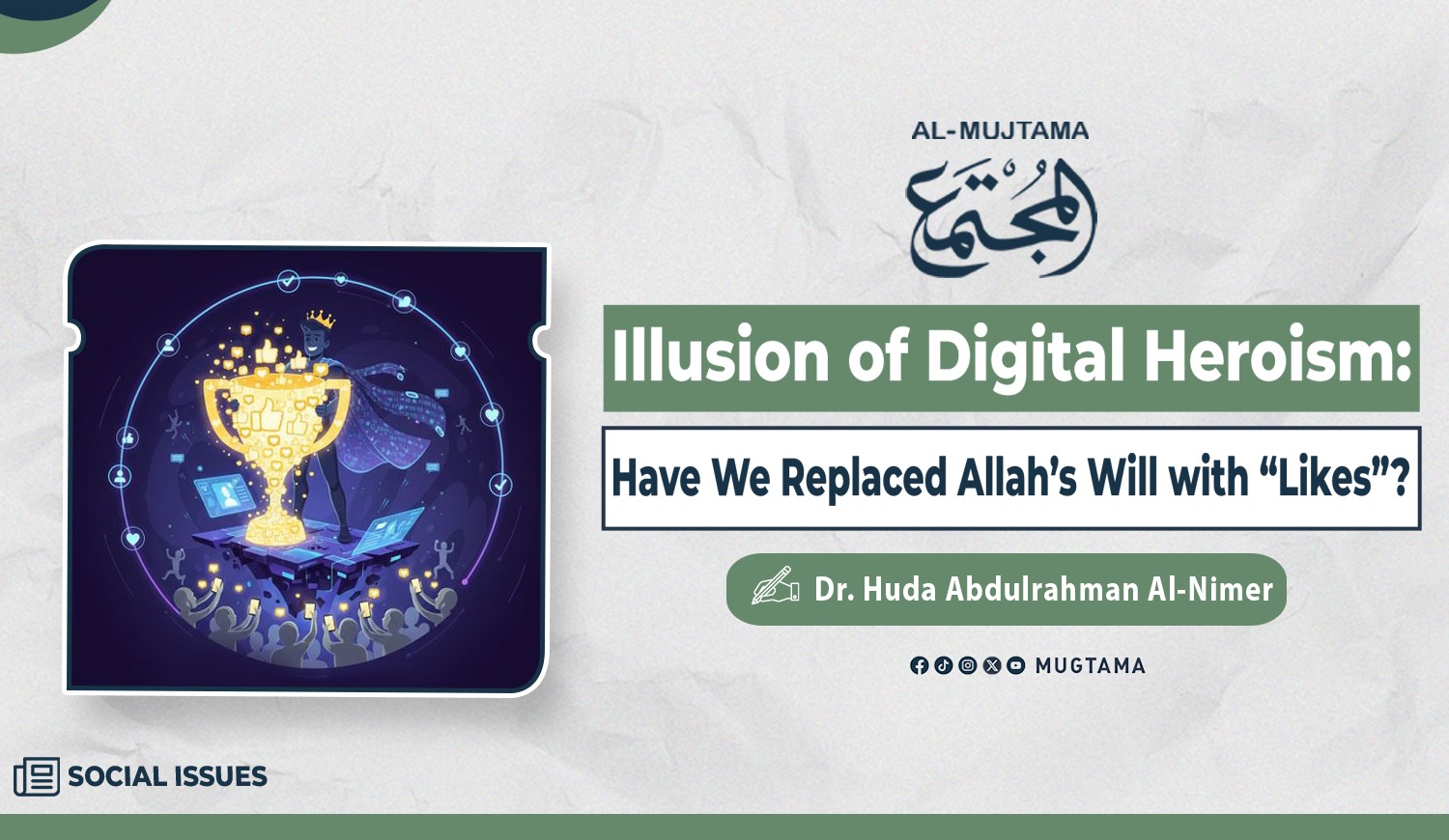
Social media has brought
about a profound transformation in the structure of human consciousness in
general, and in the perceptions of Muslim youth in particular. It no longer
functions merely as a set of communication tools, but rather as an entire
environment for producing meanings, redefining values, and shaping standards of
success and failure, significance and insignificance.
Among the most
notable phenomena produced by this environment is what may be described as the
culture of “mass visibility.” Appearance, reach, and follower counts
have become—explicitly or implicitly—central elements in evaluating people and
their work, and even in shaping how individuals perceive their place within
Allah’s will and the purpose of their existence.
In its essence,
the question of purpose is a purely devotional one: What does Allah want
from me in the place where He has positioned me?
This question
is inseparable from belief in divine decree, from understanding priorities, and from
grasping the meaning of comprehensive servitude, as Allah says: “I did not create jinn and humans except to worship Me.” (Adh-Dhariyat 51:56)
Yet under the
influence of platform culture, this question has gradually shifted from a
question of obedience to a question of positioning: Where do I stand among
people? What role will make me influential, visible, and impactful? Here
lies the confusion between Allah’s will for the servant and the inner desire
for heroism within the self—a desire that naturally feeds on praise and social
recognition.
From Worship to Visibility
This shift did
not occur suddenly. It formed gradually through a widely circulated discourse
that links value to visible impact, benefit to the breadth of influence, and
success to one’s ability to “make a difference.” While these meanings may be
valid in themselves, once detached from the scale of the Sharia and reduced to
their popularized, crowd-centered form, they become a heavy psychological and
normative burden.
Work that
remains within the circle of one’s family, or that takes place quietly in
private life, or that is not accompanied by applause, begins to feel deficient
in value—despite the possibility that it may be among the greatest acts of
devotion in the sight of Allah.
The Prophet (peace
be upon him) established a different standard of value—fulfilling
responsibility where you stand. He said: “Do not belittle any good deed, even
if it is giving a rope’s strap, or giving a sandal strap, or pouring some of
your water into the container of one who asks for water, or removing something
harmful from the road of the people, or meeting your brother with a cheerful
face, or greeting him with peace…” (1)
The Narrowing of “Benefit”
As the concept
of benefit became increasingly restricted in modern perception, Allah’s will
was subtly reduced to large-scale, outwardly visible forms of social impact.
Acts such as raising children, caring for parents, or quietly fulfilling one’s
professional duties began to be seen as transitional phases or temporary
excuses—rather than as missions in themselves.
This represents
a profound distortion in understanding. Islamic law does not measure value by
the breadth of impact, but by the sincerity of obedience and by placing every
ability where Allah intended it to be used.
This distortion
is further deepened by the constant consumption of highly visible public
figures. Followers do not merely receive ideas and content; they unconsciously
absorb the atmosphere of brilliance, engagement metrics, and curated images of
success displayed on screens.
Over time,
comparisons inevitably begin:
Why have I not achieved what they have?
Where do I stand compared to their number of followers?
What am I lacking?
Such
comparisons rarely account for the long journeys of effort, gradual
development, sincerity, or the correctness of deeds according to the principles
of the Sharia. Instead, they occur in the shadow of visible “like” counters and
apparent success, stripped of context. From here, regret emerges—turning into
frustration, then apathy, until the practical trajectory of a person’s life
ends in complete withdrawal from meaningful action.
When Good Intentions Become a Veil
Another danger
arises when this psychological state cloaks itself in the language of good
intentions. A person may convince himself that he seeks visibility only to
benefit people, spread goodness, or deliver a message.
Yet the Prophet
(peace
be upon him) warned about the subtlety of this door when he said: “Deeds are to
be judged only by intentions, and a man will have only what he intended.” (Al-Bukhari
and Muslims)
An action may
appear identical outwardly, yet differ profoundly in its weight before Allah.
How often does conveying truth become self-promotion, and introducing goodness
become boasting, if a person lacks sincere moments of solitude in which he
holds himself accountable away from the eyes of people.
The Devaluation of Quiet Good Deeds
Another
consequence of this environment is the disturbance of how deeds are valued and
the growing tendency to belittle small acts of goodness. Yet the Prophet (peace
be upon him) said a comprehensive and decisive statement: “Do not
belittle any good deed.”
The divine
scale does not recognize “small deeds” in the conventional sense. Rather, it
weighs hearts, intentions, and steadfastness. But a soul accustomed to noise
grows weary of silent work, because it carries neither applause nor echo.
Here the devil
enters through the door of discouragement, convincing a person that his efforts
are meaningless. Or desire enters through the door of spectacle, pushing him to
abandon the good already within his reach in search of something more visible and
impressive.
The Paradox of Paralysis
Paradoxically,
all of this ultimately leads to inaction. When the value of deeds becomes tied
to visibility, the soul loses the ability to persist in obscurity. When Allah’s
will is imagined only in grand achievements, a person halts his movement until
ideal circumstances appear.
He becomes
occupied with planning his “mission” instead of fulfilling his duties, waiting
for a grand project instead of cultivating the present moment.
Yet Allah says:
“So compete with one another in doing good.” (Al-Baqarah 2:148)
The command to
hasten toward goodness was not conditioned upon the magnitude of the act, but
upon the willingness to begin wherever goodness appears.
We do not need
to oppose social media, nor deny its influence. What we urgently need is
awareness that restores it to its proper place—so that it does not transform
from a tool into a scale of value, or from a medium into a source of authority.
When the scale
returns to its rightful position, deeds become light again, intentions regain
their sincerity, and the details of everyday life—small and great alike—become
arenas for fulfilling the will of Allah, rather than a prolonged stage for
waiting to play the role of a hero.
Restoring the
correct understanding of Allah’s will therefore requires liberating the heart
from the scale of mass visibility, and reconnecting actions with their
devotional meaning rather than their social image.
For Allah’s
will is recognized in steadfastness before visibility, in sincerity before
reach, and in seeking the eternal Face of Allah—even if no one else bears
witness.
Read Also:
-
How Does Social Media Shape Consumer Culture?
-
4 Moral Violations on Social Media and How Muslims Can Avoid Them
-
Parental Model Challenges in the Age of Social Media
-------------------------------------------------------------
Footnotes:
1- Musnad Ahmad: The Musnad of the Meccans — The Hadith
of Abu Tamimah Al-Hujaymi from the Prophet (peace be upon him) (15525).