





Misconceptions about Palestine (17)
Is Jerusalem Less Holy Than Mecca and Medina in Islam?
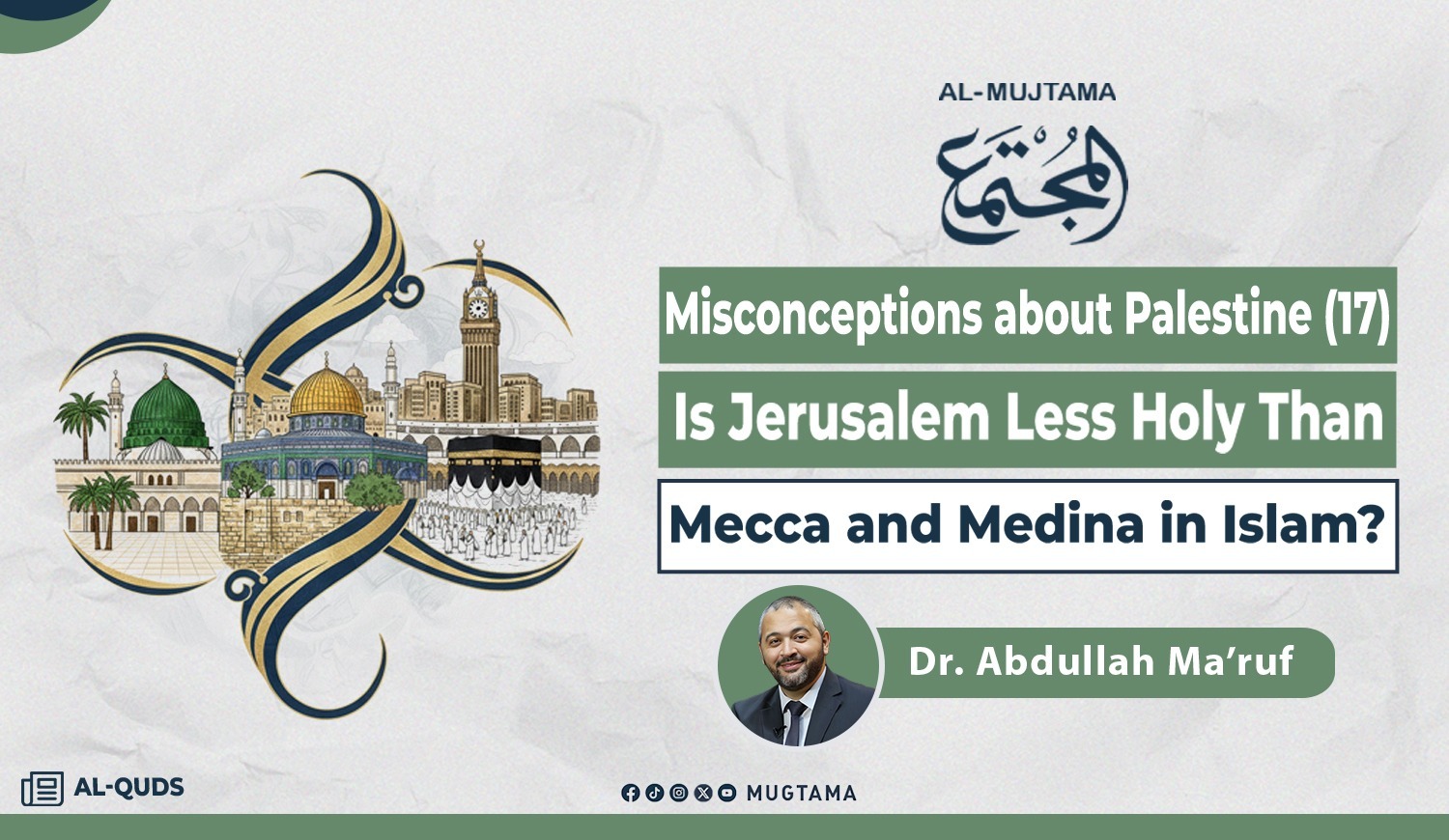
Perhaps
this misconception is the most prevalent even among Muslims themselves, due to
a misunderstanding of the religious texts concerning the Blessed Al-Aqsa Mosque and its two counterparts, the Sacred Mosque and the Prophet's
Mosque. When asked to rank these holy sites by 'importance,' most would
unhesitatingly place the Sacred Mosque first, followed by the Prophet's Mosque,
and finally Al-Aqsa.
This
rhetoric has become a gateway for opportunists seeking to undermine the
significance of Jerusalem and the Blessed Al-Aqsa Mosque. We now see a diverse
range of Zionist writers leveraging this point, arguing that while Jerusalem
holds the supreme rank in Judaism and Christianity, it remains merely 'third'
in Islam—and thus, 'less sacred' to Muslims than Mecca and Medina.
A Deliberate Divide
The
anomaly in this discourse lies in the consistent pairing of Mecca and Medina,
while Al-Aqsa is pointedly sidelined to imply a subordinate status. Whether
discussing the cities or the mosques, they are inextricably linked in
speech—Mecca followed by Medina, the Sacred Mosque by the Prophet’s Mosque—as
if Al-Aqsa were an outlier in an otherwise binary equation of holiness.
Adversarial
rhetoric has seized upon a theological nuance to downplay Jerusalem’s
significance. However, Islamic doctrine clarifies that the traditional sequence
of the three holy sites is a matter of liturgical merit, not a tiered level of
holiness. By conflating the 'multiplier' of prayer with the site’s sacred
value, critics attempt to marginalize Al-Aqsa within the Islamic worldview.
It is
widely acknowledged that prayer in the Sacred Mosque (Mecca) carries a higher
spiritual merit than in any other location. This is quantified in the
narrations of Al-Bazzar and Al-Tabarani, which state: 'A prayer in the Sacred
Mosque is equivalent to 100,000 prayers; a prayer in my mosque (Medina) is
worth 1,000; and a prayer in Bayt al-Maqdis (Jerusalem) is worth 500.' Similar
accounts are also documented by the prominent scholars Ahmad ibn Hanbal and Ibn Hibban.
However,
this prophetic tradition does not pertain to sanctity or status, but strictly
to the spiritual reward for prayer. This concept is fundamentally different
from the idea of religious standing and holiness. This distinction was likely
what the Prophet intended, as documented in the historical records of the
scholar Al-Hakim and the chronicler Al-Tabarani. In those accounts, he observed
his companions debating the relative virtues and superiority of the Prophet’s
Mosque compared to the Farthest Mosque.
Abu Dharr
reported: We were discussing in the presence of the Messenger of God which was
superior: the Prophet’s Mosque or the Holy House in Jerusalem. The Messenger of
God said: 'A single prayer in this mosque of mine is better than four prayers
there, yet what a magnificent place of worship it is. Indeed, a time will soon
come when for a man to possess a piece of land as small as the curve of a bow,
from which he can see the Holy House, will be better for him than the entire
world and all it contains.
The Implications of Equality in Sanctity and Status
The term
'The Holy House'(Bayt al-Maqdis) used here is the ancient name for the Blessed
Farthest Mosque. In this noble prophetic tradition, we see the Prophet
correcting the perspective of his noble companions, clarifying to them that any
distinction between the sites lies strictly in the spiritual reward for prayer.
For this reason, he followed his statement by saying: 'And what a magnificent
place of worship it is,' before further explaining that simply gazing upon it
is better than the world and all it contains.
This
explains the variation in the ordering of the three houses of worship within
the well-known tradition regarding sacred journeys: 'One should not
specifically set out on a journey except to three mosques.' In some narrations,
the Prophet’s Mosque is mentioned first; in others, the Sacred Mosque takes
precedence, while some versions prioritize the Farthest Mosque. This
inconsistency demonstrates that the sequence does not reflect a hierarchy of
religious status but rather pertains solely to the spiritual rewards of prayer.
For this
reason, as recorded by Al-Waqidi, we saw Umar bin Al-Khattab insist that Bilal bin Rabah be the first to
deliver the call to prayer at the Farthest Mosque. Since he was the first to
perform this call at the Prophet’s Mosque and the Sacred Mosque, it was
necessary for him to be the first caller at the Blessed Farthest Mosque. This,
in itself, is an indication of the equality in sanctity and status between
these holy sites; for the difference in the spiritual rewards for prayer is one
thing, and the difference in status is quite another.
You may
also like:
Jerusalem From Tactical Planning to Umar's Treaty