








Islamization of Knowledge
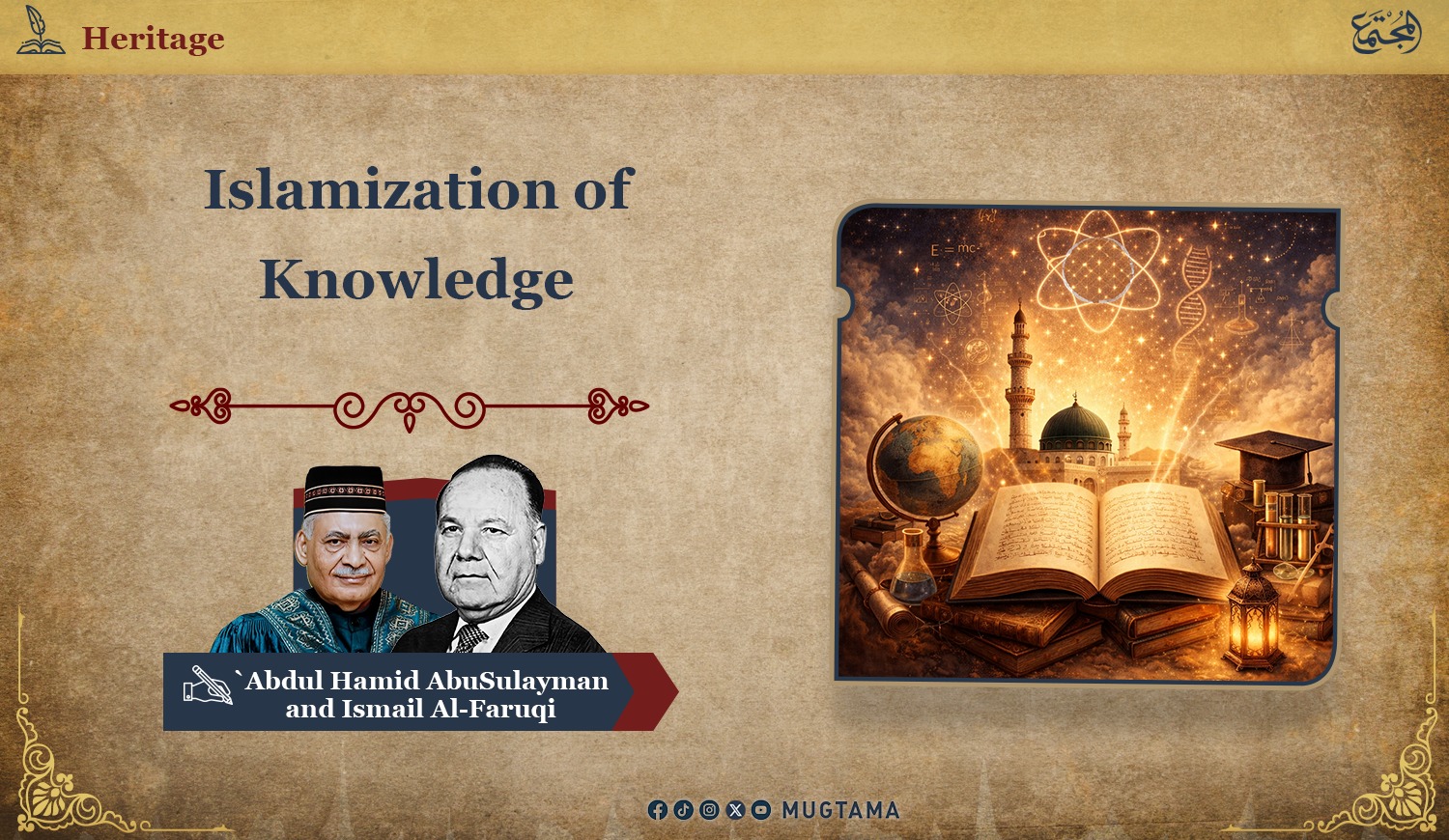
It must be made clear that the "Islamization of knowledge" represents only one aspect of "Islamization". In its entirety, "Islamization of knowledge" is the comprehensive, normative framework for individuals and society, for thought and action, for education and practice, for knowledge and organization, for the rulers and the ruled, for this world and for the world to come. By applying "Islamization" to everything one does, a Muslim seeks the pleasure of Allah (SWT) by practicing what is true and just, through transformation and improvement, to achieve happiness, peace and security in this life as well as in the hereafter.
Central
Role of Islamization of Knowledge
The
"Islamization of knowledge" is of fundamental importance and occupies
foremost priority in actualizing "Islamization". It is concerned with
thought, ideology, and a normative and ideational human pattern—and how such a
pattern, its constituents, its roots in reason, psyche, and conscience may be
built. This makes the "Islamization of knowledge" a prerequisite as a
foundation for erecting the superstructure of the Ummah, for forming its
individual and collective outlook on life, and for developing both its
ideological and practical aspects.
Therefore, the
"Islamization of knowledge" cannot be neglected nor can its priority
be overlooked or buried beneath heavy pressures of political, economic and
military problems of the Ummah. At a time when we are forced to fight and
defend ourselves on political, economic, and military fronts, these efforts may
prove abortive and may simply dissipate the resources and energies of the Ummah
unless we organize our struggle properly and develop the real powerbase of the
Ummah.
This can be
accomplished by developing its ideological power and the power of the
"Islamization of knowledge" to effectively harness its full potential
and energies. It is, therefore, necessary to build and restructure correct
principles for genuine "Islamic intellection" and to create the
conditions conducive to its existence and growth by erecting the lofty edifice
of "Islamic knowledge".
Methodology
and Nature of Islamic Knowledge
"Islamic
knowledge", or the "Islamization of knowledge", requires a
proper and comprehensive Islamic methodology that seeks guidance from the
revelation but does not render reason inert nor suspend its role. It reflects
the objectives, norms, and ultimate purposes of revelation. It studies and
grasps the guidance given by revelation to individuals and society for
constructing, transforming, and improving all that Allah (SWT) has created.
Through the
"Islamization of knowledge", the Ummah is cognizant of the need and
importance of the scientific and cultural achievements that the human race has
inherited and achieved. However, these must be thoroughly examined and
critically checked in the light of Islam, its comprehensive norms, its guidance
and its ideals.
The
"Islamization of knowledge" represents a type of knowledge based upon
revealed norms and ideals of the Divine message. It is related to all that is
true, valuable, and precious in the legacy of the Ummah and the thought content
of its scholars and thinkers over the centuries.
It is not just
"norms and ideals", nor "individual meditations", nor
merely "history and legacy". Rather, it is a method to formulate a
scientific and intellectual approach to the humanities, social sciences and
applied sciences. It is rational in its outlook, critical in its examination,
and comprehensive in its treatment of life, society, and nature.
Future
of the Ummah
For the Ummah,
the "Islamization of Knowledge" is a matter of utmost priority. It
aims at developing a methodology for Islamic ideology—purifying it of
aberration, corruption, isolation, inertia and division. It seeks to
reinvigorate Islamic thought and enable mastery across various branches of
knowledge in order to build a sound contemporary Islamic foundation for action
in all spheres of life.
The importance
of reforming thought and methodology does not imply neglecting other
activities. Rather, it ensures that all efforts—political, economic, social,
and military—are effective and properly directed. Without such reform, all
sacrifices and resources risk being wasted.
The proposed
"Islamization of knowledge" provides the Ummah with vision,
methodology, and intellectual strength to confront contemporary challenges. The
Ummah does not lack sincerity or resources, but it lacks sound thought, clear
vision, and precise methodology.
History shows
that civilizations rise through intellectual reform. Even Europe, in its
confrontation with Islam, advanced by learning from Muslim achievements. Thus,
Muslims must also learn from history and rebuild their intellectual
foundations.
Giving priority
to the "Islamization of knowledge" does not negate other efforts;
rather, it complements them. Its objectives are to equip the Ummah with the
tools, clarity, and strength needed to fulfill its role and to navigate a
changing world full of challenges and opportunities.
In its widest
sense, "Islamization" is a framework for human life and civilization.
While all aspects of life require attention, prioritizing the
"Islamization of knowledge" is essential as a foundational step
toward revival, clarity of vision, and the ability to endure and succeed.
Read Also:
-
Technology Under the Lens of Human Ethics
-
Space Science Brings One Closer to Allah and the Quran
-
Science Serves Revelation, Not Rivals It
-------------------------------------------------------------
Source: Islamization of Knowledge by `Abdul Hamid AbuSulayman and Ismail Al-Faruqi