


Israel Escalates Al-Aqsa Restrictions to Assert Control Before Ramadan
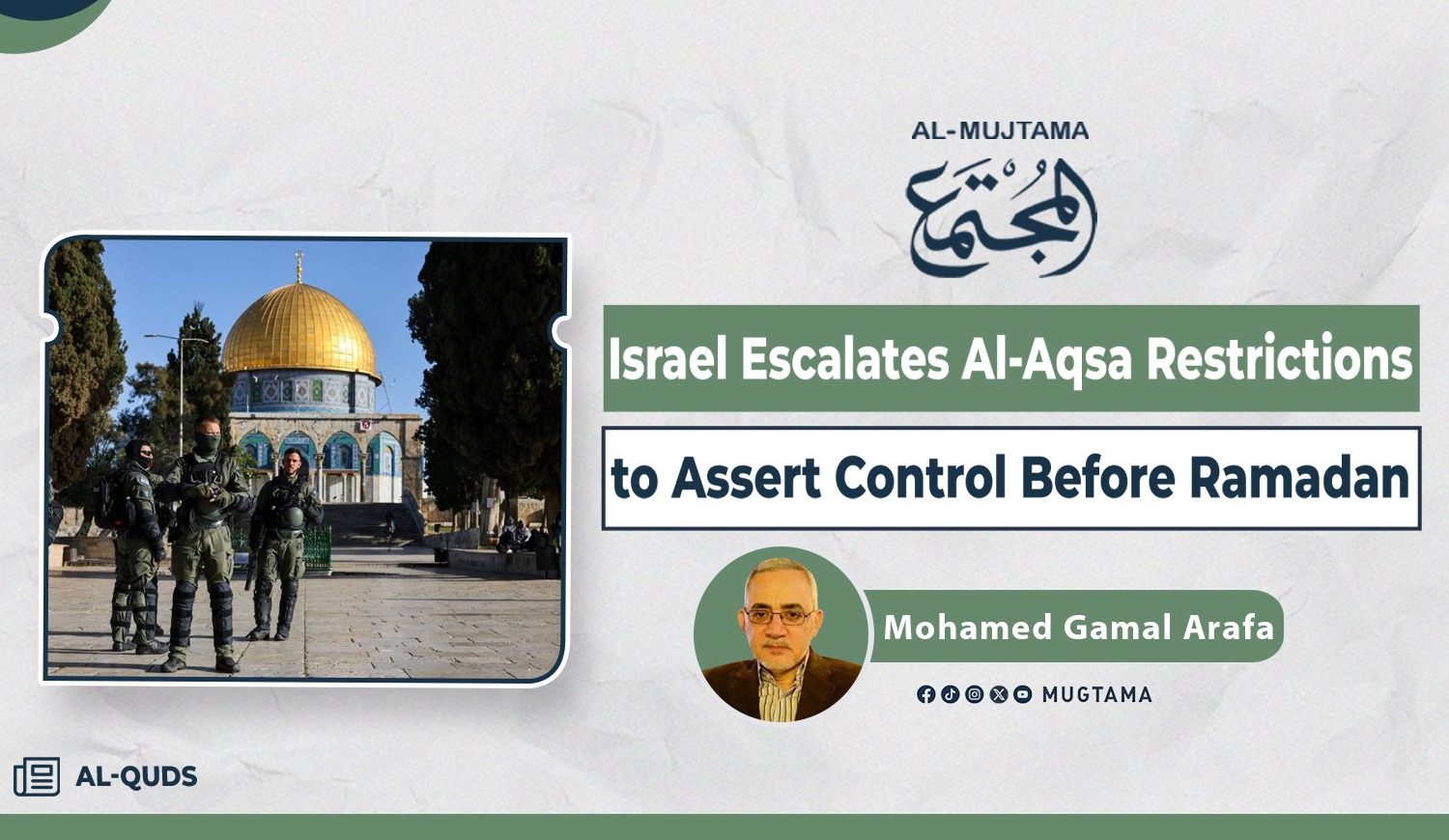
As Ramadan approaches, the occupation authorities are
intensifying restrictions on worshippers and residents of the West Bank and
Jerusalem. However, these measures coincide with a broader, two-year escalation
of efforts to fundamentally alter the status quo in Jerusalem and the Al-Aqsa
Mosque. These moves represent a systematic attempt to impose a new de facto
reality and assert full Israeli sovereignty over the holy site.
Ahead of Ramadan 2026, the occupation authorities have
implemented a series of measures that Palestinians and international observers
interpret as a strategic move to entrench control over the Al-Aqsa Mosque.
These actions go beyond the restrictions of previous years, significantly
curtailing Palestinian access and marking a sharp escalation in the effort to
reshape the sanctuary’s status.
Extensive Curbs
The occupation has imposed sweeping restrictions on
worshippers from the West Bank, while banning I'tikaf and other traditional
Ramadan religious observances. Alongside a heavily intensified security
presence, authorities have simultaneously facilitated settler incursions under
armed protection. These moves are seen as a systematic effort to impose a
spatial and temporal division of prayer at Al-Aqsa between Muslims and Jews—a
policy mirroring the status quo previously forced upon the Ibrahimi Mosque in Hebron.
The ultimate and true objective behind these policies is to
strip Al-Aqsa Mosque of its inherent sovereignty and establish absolute Jewish
control. This campaign is part of a broader war against Palestinian national
and religious symbols. The aim is to normalize Israeli jurisdiction over the
site—treating it no differently than Tel Aviv—thereby paving the way for the
future imposition of Jewish prayer within its courtyards.
The occupation authorities have enforced a convoluted permit
regime, granting access to only a fraction of West Bank Palestinians seeking to
pray at Al-Aqsa. These permits are subject to rigorous security vetting, a
process that has drastically reduced the number of worshippers compared to
previous years.
In a significant departure from previous years, the occupation
has begun permitting increased Israeli settler incursions into the Al-Aqsa
compound during Ramadan—a practice that was largely restricted in the past to
prevent escalations. This year, these incursions are being carried out under
the explicit protection of Israeli security forces, further heightening
tensions during the holy month.
Expanding Control
As Ramadan approaches, far-right National Security Minister Itamar Ben-Gvir has initiated new measures to
tighten control over Al-Aqsa Mosque. This includes the dismissal of Jerusalem’s
police chief, Amir Arzani, who had reportedly opposed Ben-Gvir's plans for
incursions into the sanctuary to avoid potential unrest. In his place, Ben-Gvir
has appointed a hardline official to ensure the execution of his strategic
agenda.
Hassan Khater, head of the Jerusalem Commission for the
Defense of Holy Sites and director of the International Jerusalem Center,
warned in press statements of a 'conspicuous international absence' regarding
the current events in Jerusalem. He stressed that this global silence provides
the occupation with a 'green light' to persist in its Judaization efforts,
violate the sanctity of Al-Aqsa Mosque, and impose new facts on the ground
without any deterrent.
He explained that with the world’s attention fixed on the Gaza
Strip, Al-Aqsa Mosque has seen its prestige and sanctity eroded. The holy site,
he argued, has been transformed into a mere arena where Jewish extremists
compete to broadcast provocative slogans and perform rituals, cynically
capitalizing on the distracted international climate.
Ziad Ibhais, a researcher specializing in Al-Aqsa affairs,
asserts that the sanctuary has undergone fundamental shifts during the ongoing
genocidal war. He argues that the mosque has been transformed into a
battleground for the comprehensive liquidation of its identity, where its
historical and religious character is being systematically dismantled.
This trajectory of control traces back to September 16, 2023,
during an extended season of Jewish holidays. At that time, the occupation initiated a siege
policy on Al-Aqsa, barring all worshippers except for Waqf employees and
elderly residents of the Old City. These restrictions typically spanned from
the night prayer (Isha), through dawn (Fajr), and lasted until the afternoon
(Asr) of the following day.
The objective of this policy was to grant Zionist forces
exclusive control over the Al-Aqsa Mosque compound for a period of 22 days amid
sustained aggression. This measure aimed to prevent any form of religious
retreat (i‘tikaf) and to bar the early-morning presence of the
Murabitun—Palestinian worshippers and guardians who regularly maintain a
protective presence at the site.
Following the launch of Operation Al-Aqsa Flood on October 7, 2023, the occupation intensified its siege of
the mosque for several weeks. Entry was so strictly curtailed that, at times,
worshippers failed to form even a single row within the Al-Qibali Mosque. For
ten consecutive weeks after the start of the genocidal war, Friday prayer
attendance did not exceed 5,000 people. These draconian measures were only
slightly relaxed during Ramadan, specifically on the 27th night.
Throughout 2024 and 2025, this policy persisted with periodic,
relative easing of restrictions. High-profile occasions—most notably the Last
Friday of Ramadan and the 27th night—were strategically utilized as a smoke
screen to mask the reality of the permanent and ongoing siege of Al-Aqsa
Mosque, which continues to this day.
Undeclared Synagogue
The Hebrew New Year escalation, from September 23 to 25, 2025,
witnessed dangerous developments. Settlers, backed by the occupation’s army and
police, effectively transformed the eastern area of Al-Aqsa Mosque into an
undeclared synagogue within the sanctuary's courtyards. During this period,
they performed biblical rituals, including blowing the shofar and holding
communal prayers, completely unhindered and without any intervention from the
authorities.
As part of the efforts to impose spatial and temporal
division, the occupation has significantly extended the daily windows for
settler incursions during the ongoing genocidal war. These hours have now
reached six hours and fifteen minutes daily—a staggering increase from the
three-hour window originally established in 2008.
The occupation has successfully monopolized the eastern
courtyard of Al-Aqsa, treating it as an undeclared synagogue. Throughout 2024,
Palestinian worshippers were strictly banned from the settlers' paths, granting
Zionist groups unfettered freedom to act as the de facto owners of the site.
Meanwhile, the indigenous Muslim worshippers were confined to the Al-Qibali
Mosque or the inner platform of the Dome of the Rock.
Furthermore, Jordanian Waqf guards were prevented from
reaching their open service points along the incursion routes, forced instead
to remain inside buildings and domes. The sounding of the shofar was a
calculated attempt to establish a Torah-based ritual identity parallel to the
mosque's Islamic character. Crucially, in 2026, an unprecedented information
blackout was imposed; for the first time, neither guards nor worshippers could
monitor the aggression in the eastern courtyard, which the occupation now operates
entirely as a sovereign Jewish prayer space.
Every year, so-called 'Temple Mount organizations' strive to
break records for the number of settlers storming the Al-Aqsa courtyards. This
mobilization aims to lay the groundwork for the construction of the alleged
'Third Temple' by normalizing large-scale incursions. The most recent record
was set in August 2025, when more than 3,000 settlers entered the site in a
single day.
Parallel to these incursions, the occupation has accelerated
the militarization of Al-Aqsa. This includes the installation of barbed wire
fencing atop the mosque’s perimeter walls at strategic points. These
fortifications are designed to seal off entry routes previously used by
worshippers during periods of overcrowding or through adjacent homes,
effectively turning the sanctuary into a fortified military zone.
The most alarming shift occurred during Ramadan 2024, when
armed occupation police patrols began circulating the courtyards during prayer
times. This move fundamentally undermined the core equation established since
the 1967 occupation and directly violated the historic 'Status Quo' that had
governed the sanctuary for decades.
Beyond the physical barriers, worshippers are subjected to
mandatory identification checks and intrusive searches of Iftar meals.
Religious circles are frequently disrupted as scholars and preachers are
interrogated mid-lesson. Simultaneously, the role of the Jordanian Islamic Waqf
has been systematically marginalized; once the sole custodian managing
Al-Aqsa’s affairs for decades, it has now been reduced to a mere administrative
body, forced to operate within the narrow confines of Israeli-imposed restrictions.
Far-right National Security Minister Itamar Ben-Gvir has
mandated the facilitation of public, collective Jewish rituals within Al-Aqsa
Mosque, personally leading these efforts on several occasions. These
rituals—which include singing, clapping, and group dancing—represent a total
breach of the established Status Quo agreed upon following the 1967 occupation.
This systematic shift is aimed at imposing a parallel Jewish identity on the
sanctuary, directly challenging its Islamic character.
You may also like:
The Torah Feast of Tabernacles: Increasing Al-Aqsa Raids and Ben Gvir’s Provocations
Amid Islamic World Silence, Ben Givr Stormed Al Aqsa and Al Ibrahimi Mosques
Resilience Under Fire: 5 Tools of Jerusalemite Resistance Against the Occupation
_____________________________