







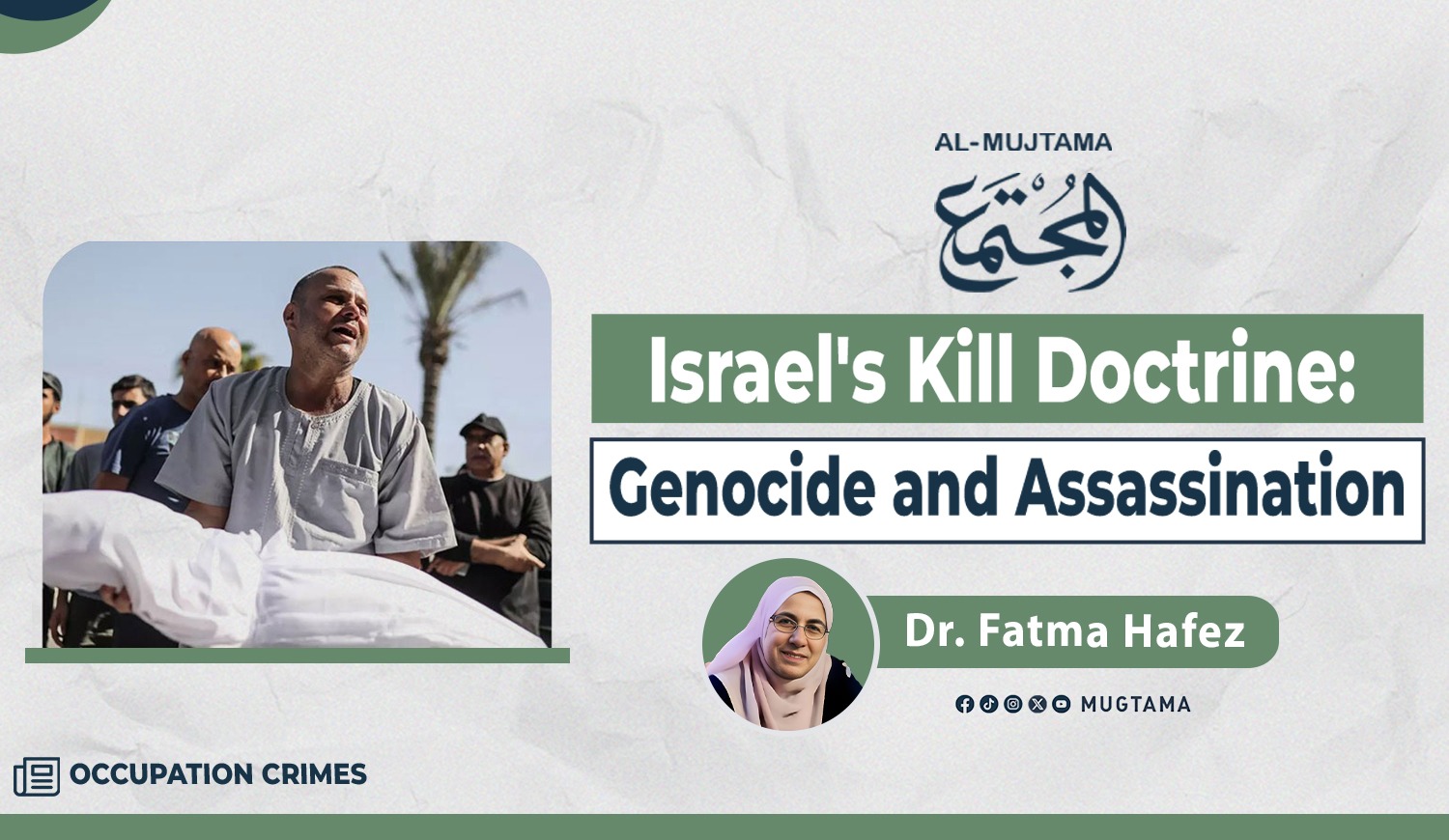
Israel's Kill Doctrine: Genocide and Assassination

Since its
founding, the Zionist project has been inseparable from the extreme violence
carried out by the armed Haganah militias (1). This pattern has persisted to
the present day: Israel has committed one of the most egregious acts of
genocide in modern history in Gaza, accompanied by a series of successive
assassinations across several neighboring countries — and most recently, it has
passed a law sanctioning the extrajudicial execution of Palestinian prisoners,
in an absolute license to kill those it designates as enemies or whom it refers
to as "goyim."(2)
In the
following lines, we examine the origins of the concept of genocide and its
implications, and how it combines with political assassinations to form the
core of Zionist violence doctrine.
The Invention of Genocide
Mass
killing has marked human history since antiquity, documented in historical
sources as massacres and slaughters claiming thousands of innocent victims. Yet
it was only in the final stages of World War II that the concept of
"genocide" emerged — coined by a Polish-Jewish lawyer named Raphael
Lemkin, who sought to characterize Nazi atrocities against Jews as a distinct
category of crime. The term gained rapid currency: the United Nations adopted
it as an official term in 1946, approximately two years after it was first
formulated. Shortly thereafter, genocide was recognized as an imprescriptible
criminal offense in both peace and war, with the adoption of the Convention on
the Prevention and Punishment of the Crime of Genocide in 1948.
According
to the Convention, genocide means the commission of acts with the intent to
destroy, in whole or in part, a national, ethnic, racial, or religious group,
such as:
· Killing
members of the group.
· Causing
serious bodily or mental harm to members of the group.
· Deliberately
inflicting on the group conditions of life calculated to bring about its
physical destruction in whole or in part.
· Imposing
measures intended to prevent births within the group.
· Forcibly
transferring children of the group to another group.
Examining
this definition reveals a number of notable limitations in its wording. It does
not encompass starvation or the denial of medicine — omissions that may well
have been deliberate, allowing the term to be selectively deployed to
stigmatize certain states or groups with the charge of genocide. The definition
also fails to address how to distinguish between "mass killing" and
genocide — or, put differently, whether there is a specific number or
proportion of victims that constitutes evidence of genocide. Finally, it
requires proof of intent to deliberately destroy, which is an exceptionally
difficult standard to meet, since perpetrators of genocide never openly declare
their actions as such, and typically carry them out under cover of false
pretexts.
In any
case, since the Genocide Convention entered into force and was ratified by
upwards of 150 states, the international community has repeatedly failed to
intervene to prevent genocides in Bosnia, Rwanda, Turkestan, and Gaza. No state
has ever been convicted of genocide — with only a handful of individuals
brought to justice through trials that can stretch on for years. This culture
of impunity has emboldened Israelis to carry out genocide without fear of legal
consequences, despite the case brought against Israel by South Africa before
the International Court of Justice.
From Genocide to Assassination
Genocide is not the only form of violence
practiced by Israel. Alongside it stands a policy of assassination that equally
traces its roots to the pre-state era, when Zionist militias systematically
eliminated individuals deemed to pose a direct or indirect threat. This
assassination policy has persisted to the present day, with one notable
distinction: what was once carried out by irregular Zionist militias is now
executed by the state itself, which shows no hesitation in targeting military
figures or even civilians — as demonstrated by the assassinations of Iranian
nuclear scientists, and before them, Al-Zawari, the
Tunisian drone engineer who had placed his scientific expertise at the service
of the resistance
Despite
the age-old nature of assassination as a practice, this political tool has
undergone a number of significant transformations, including:
1- The
dramatic expansion of assassinations, both within occupied Palestine —
particularly the West Bank, where Israel has eliminated an entire generation of
Palestinian resistance fighters in the northern West Bank camps of Jenin, Nur
Shams, and Tulkarem — and geographically, extending its reach to Iran, Turkey,
and several Gulf states.
2- The
elevation of targeted profiles, to include senior leaders and political
figures such as Hassan Nasrallah and Ali Khamenei — individuals who would never
have been considered legitimate targets prior to the October 7th Al-Aqsa Flood
operation.
3- The
shift from individual to mass assassination, most notably demonstrated by
Israel's detonation of pager devices targeting thousands of Hezbollah
operatives, alongside the systematic elimination of Islamic Revolutionary Guard
Corps commanders and Iranian nuclear scientists.
Several
factors underpin the adoption of assassination as state policy. Some are legal
in nature, rooted in the absence of any meaningful deterrent: although
political assassination is a condemned act under the Fourth Geneva Convention
and should be prosecuted as a war crime or a crime against humanity,
enforcement remains virtually nonexistent. Others are religious in character,
typically involving the dehumanization of victims, coupled with the invocation
of Torah and Talmudic texts that sanction — and even glorify — the killing of
non-Jews.
From a
purely pragmatic standpoint of gains and losses, assassinations can yield
strategic advantages that are difficult to overlook, such as:
1- Disrupting
command and control, as the assassination of senior leadership or
first-tier commanders creates a temporary leadership vacuum and severs
communication links between the upper echelons and lower ranks.
2- Eliminating
irreplaceable assets — military figures, historically significant leaders,
and technical experts whose loss cannot be compensated for in the short term.
3- Terrorizing
the adversary, as assassination — particularly when carried out in
sovereign capitals — sends an unambiguous message that Israel's reach extends
to any individual, anywhere.
4- Leveraging
assassinations for domestic purposes, by exploiting such operations to
boost morale at home, promoting them as proof of Israel's superior capacity to
deter its enemies and provide security for its citizens.
5- Minimizing
material costs, given that direct military confrontation demands far
greater resources than targeted assassination operations, making assassination
the more strategically economical option.
Despite
these gains, assassinations carry considerable potential risks. The elimination
of leadership figures generates intensified desires for retaliation and
provides additional justifications for hostility. Furthermore, those who
replace the assassinated leaders may prove more hardline and more violent than
their predecessors. On another front, assassinations accelerate the erosion of
Israel's international legitimacy, and prompt neutral states to contemplate
whether they too might become potential targets. Finally, assassination
operations project an image of Israel to global public opinion not as a state
governed by policy and rule of law in its dealings with adversaries, but as a
criminal enterprise that operates through killing and elimination.
The
Zionist project was founded upon violence in all its forms and has never
abandoned it — indeed, the very survival of the project remains contingent upon
the perpetuation of violence. Yet this same violence breeds ever-deepening
desires for retribution in the hearts of the land's original inhabitants,
driving them toward resistance regardless of its cost. This raises fundamental
doubts about the long-term viability of a project that rests on violence alone,
divorced from the essential foundations of survival: security and stability.
You may
also like:
January 5Marks Zionist Assassination of Yahya Ayyash
Footnotes by editor:
1.
Haganah: A Zionist
paramilitary organization established in 1920 during the British Mandate for
Palestine. Originally formed to protect Jewish settlements, it evolved into a
highly organized military force. Following the 1948 declaration of the State of
Israel, it served as the primary foundation and structural core upon which the
Israel Defense Forces (IDF) were established.
2.
Goyim (Gentiles): A Hebrew
term used to refer to individuals or nations who are not Jewish. Linguistically
derived from the Biblical Hebrew word "Goy" (meaning
"nation"), the term evolved over time to distinguish between Jewish
and non-Jewish people in religious, social, and historical contexts.