
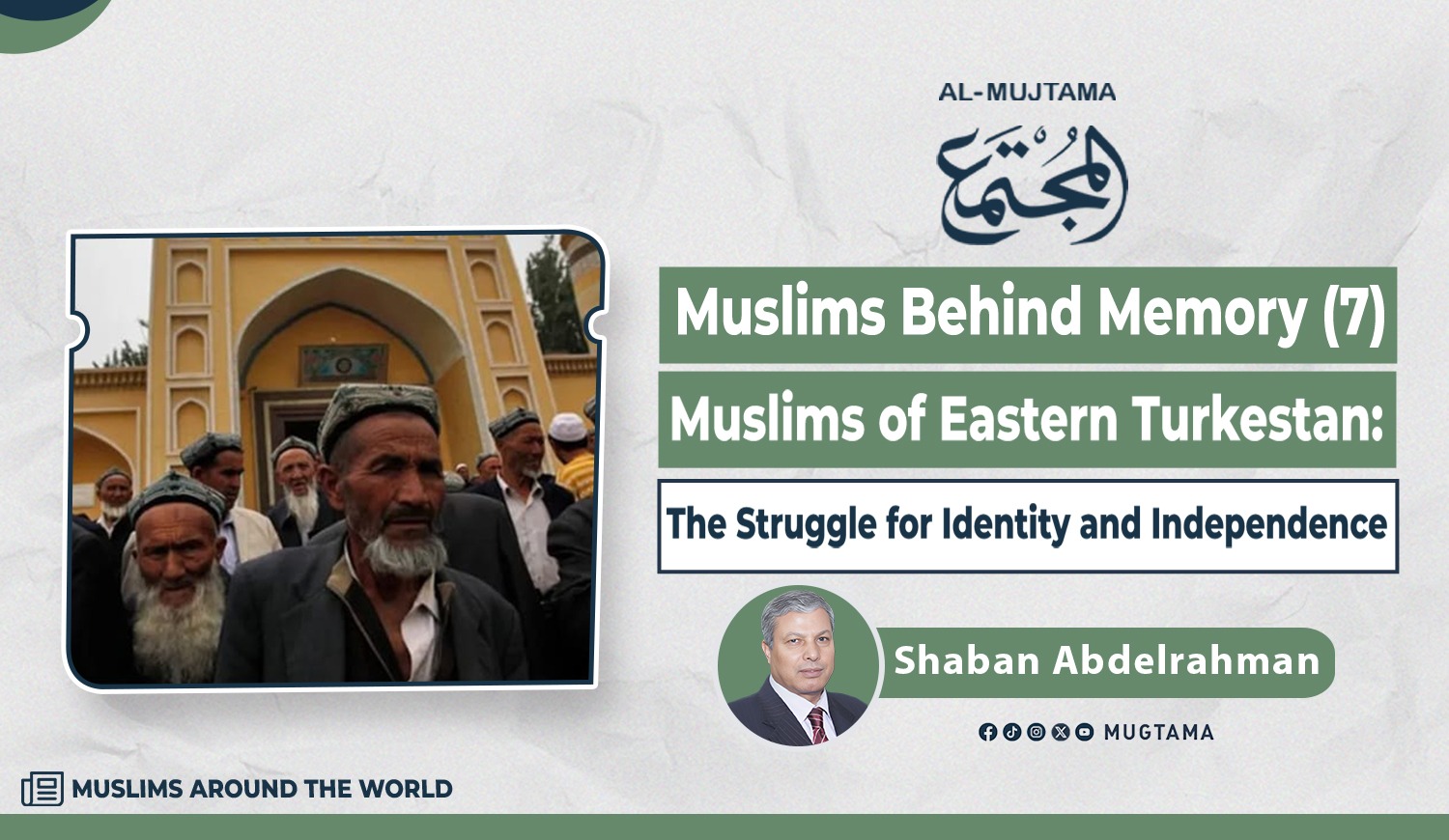
Muslims Behind Memory (7)
Muslims of Eastern Turkestan: The Struggle for Identity and Independence
Distribution of Muslims in China and Turkestan
Muslims of China and Turkestan (Eastern and Western) are
distributed across Chinese and Soviet territories before the dissolution of the
Soviet Union in 1991. There are also communities in adjacent and nearby
regions. These lands host diverse populations that together represent a
significant Islamic geographical, demographic, economic, and social weight,
numbering more than 138 million according to the 2022 census.
Division of Turkestan
Had Turkestan remained united without being divided into two
parts (Eastern and Western Turkestan), it would have become a powerful force
with effective influence in international politics and the global economy,
adding to Muslims worldwide a major strength comparable to the United States
and the communist bloc led by China and the Soviet Union before its collapse.
But the Soviet Union and communist China seized this power, divided it, and
launched successive colonial campaigns on its lands. The result was its
partition into two: Eastern Turkestan, which fell under Chinese control, and
Western Turkestan, which was occupied by the Soviet Union and further
fragmented into five states—Kazakhstan, Uzbekistan, Turkmenistan, Kyrgyzstan,
and Tajikistan—now known as Central Asian states. Other Islamic components
remained within the fallen Soviet Union and the Russian Federation, in addition
to Hong Kong and Taiwan.
Communist Expansion
Thus, the communist empires—China and the Soviet Union before
its collapse—devoured these Islamic lands with their vast wealth, strong
economy, and large population, turning them into fuel for building their new
empires. They carried out relentless campaigns of oppression, killing,
fragmentation, assimilation, and displacement against their peoples, aiming to
weaken them and make them fit only to serve the construction of the Chinese
state and the Soviet empire, without enabling them to build any independent
power or unified state. They turned them into scattered minorities, deprived of
basic rights in education, economy, and state-building, forced into labor and
stripped of their identity.
Forgotten Muslims
This is one aspect of the forgotten Muslims who once dominated
the world but were later crushed by colonial powers, subjected to oppression,
poverty, and backwardness. It is necessary to pause before their history to
inform people—especially Muslims worldwide—about them and their current
conditions.
The Chinese Conflict and the Future of Eastern Turkestan
In the April 1998 issue of International Politics
magazine (Al-Ahram Foundation, Egypt), entitled “China: Problems of Transition
and Consequences of Reform,” fourteen articles over 120 pages analyzed China’s
political, ideological, and economic experience. Among them was a deep
scholarly article on “The Chinese-Turkestani Conflict and the Future of Eastern
Turkestan,” written by Professor Dr. Mohamed Harb, a distinguished Turkish
studies scholar. He affirmed that Eastern Turkestan is a Turkish state occupied
by China in the 18th century, forcibly renamed Xinjiang—meaning “new colony”—by
official decree on November 14, 1884.
History of Conflict and Independence
Dr. Harb analyzed the conflict between China and Eastern
Turkestan since the first Chinese invasion in 1759, which lasted about a
century until the Turkestani people achieved independence in 1865. Ten years
later, China reoccupied Eastern Turkestan, but the people expelled Chinese
forces and regained independence in 1933. However, Soviet ambitions led to
Russian occupation in 1934, only a year after independence.
During World War II (1939–1945), Russia weakened, and Germany
advanced into Soviet lands. China seized the opportunity and occupied Turkestan
for the third time. In 1944, a massive revolution led by religious scholar Ali
Khan declared independence again. But in 1949, Russia and China allied to
overthrow the independent government. The revolution’s leader was kidnapped,
and Turkestani nationalists were forced into a settlement with China, which
promised them autonomy but later betrayed its commitments, launching bloody
persecution campaigns and reoccupying Eastern Turkestan for the fourth time.
Massacres followed, and China began a plan to assimilate the Muslim population
into the vast communist majority. Hundreds of thousands fled to Turkey, Saudi
Arabia, and other Muslim countries. Eastern Turkestan remains under Chinese
control to this day.
The Horrors of “Sinicization”
Dr. Harb highlighted the horrific plan of “Sinicization,”
aiming to settle tens of millions of Chinese in Eastern Turkestan to erase its
Islamic identity and forcibly transform it into a Chinese province. This began
with the 1759 occupation, when Chinese forces killed about one million Muslims.
Since then, China pursued a settlement policy known as “Sinicizing Eastern
Turkestan.” Muslims resisted with liberation wars, achieving independence in
1933, but Russia crushed the Islamic republic in 1934. Thus, Eastern Turkestan
endured repeated occupations and brief independence, with Chinese control
continuing today.
Cultural and Social Sinicization
Chinese communist rule targeted every aspect of thought and
culture to serve its colonial and atheistic aims of dissolving Islamic
identity. Articles and books praised Chinese leaders regardless of their
oppression of Muslims. Media urged Muslims to adopt Chinese Buddhist social
traditions, such as drinking alcohol, eating pork, and intermixing under the
pretext of friendship and unity. Mixed marriages between Muslims and Buddhists
were encouraged with financial and professional rewards. Any criticism of such
marriages—despite Islam’s prohibition—was deemed hostility toward Chinese
people, incitement to sedition, and punishable by imprisonment.
Changing Demographics
After its latest occupation, China brought massive numbers of
Chinese migrants to Eastern Turkestan, turning the native Muslim population
into a minority in their own land. Private property and religious institutions
were abolished, mosques were converted into clubs, cafes, cinemas, and
theaters. Muslims were forced to raise pigs and intermarry with Chinese. Arabic
language and Islamic history were removed from curricula, replaced with Chinese
language and history, aiming to kill the spirit of Islam. The Cultural
Revolution sought to destroy everything opposing communist culture, declaring
Islam illegal and punishable.
Resistance and Uprisings
Despite this, Muslim revolutions in Eastern Turkestan and
defensive wars from the mountains against Chinese forces were carried out in
the name of Islam. Martyrs fell under communist bullets while proclaiming Allahu
Akbar. The uprisings of Eastern Turkestan’s people were numerous, with
thousands of martyrs, though China concealed news of these revolts from the
world.
The people of Eastern Turkestan remain steadfast in their
faith, resisting the war of identity change and demographic transformation.
------
Writer's Mail: shaban2012 @gmail.com
Read also:
Muslims
Beyond Memory (4)
Muslims
Beyond Memory (5)
Muslims
Beyond Memory (6)