








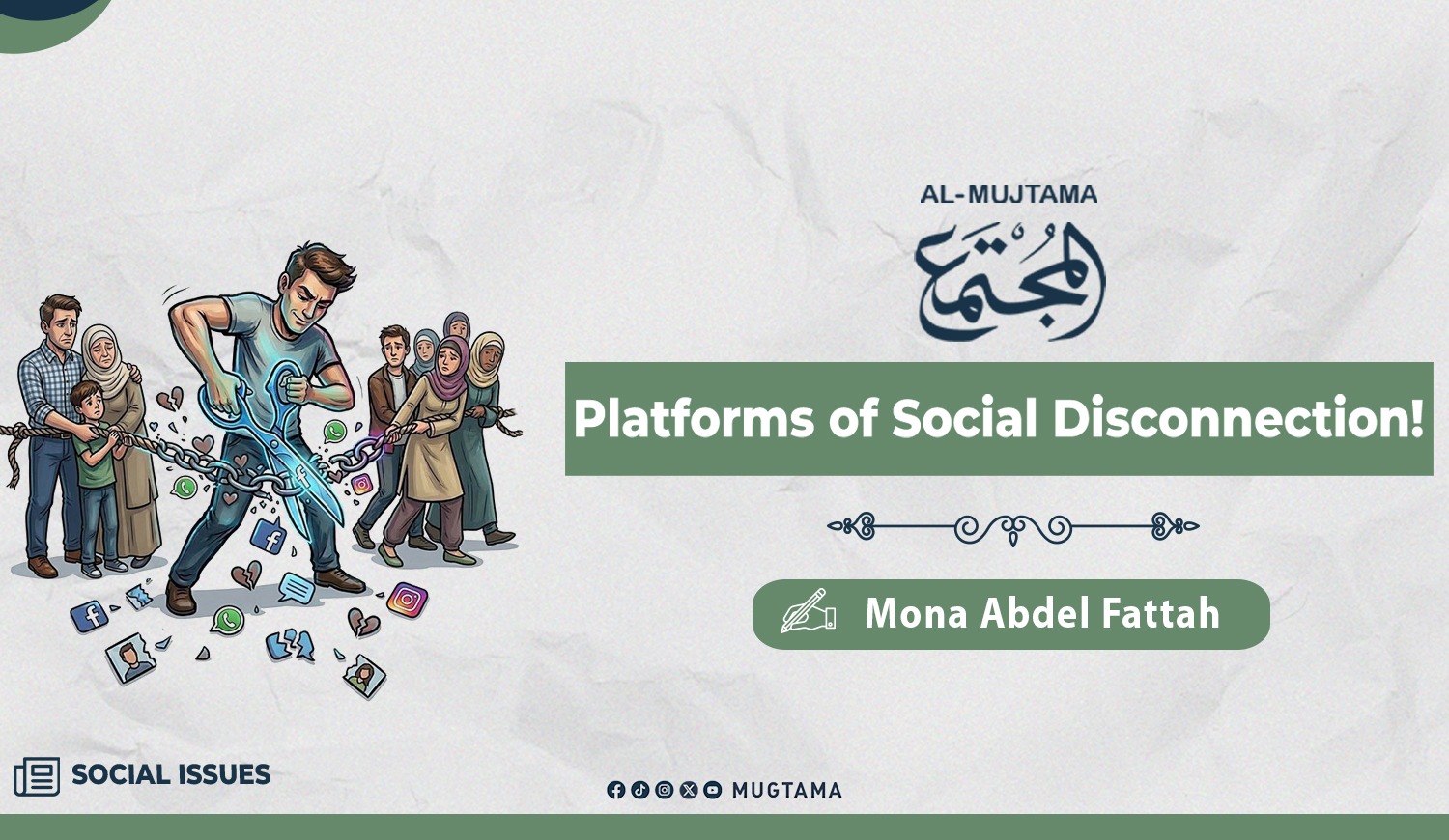
Platforms of Social Disconnection!
“Did you offer
condolences to so-and-so on the death of his father?”
“Yes, I sent my condolences via Facebook!”
“Did you attend
your relative’s wedding?”
“I watched it through a live stream and sent my congratulations in a video
message.”
“Did you
congratulate your friend on his success?”
“Of course, I sent him a message on WhatsApp.”
These are
examples of answers many of us give today regarding social and family
occasions—events that, before the rise of social media, held a certain
sanctity, rooted in maintaining family ties, affection, compassion, mutual
support, and solidarity.
Some may argue
that communication technologies have revolutionized conversations and
correspondence between people across countries and continents—and that is true.
However, they have also imposed a new pattern of “remote” relationships.
Artificial
Hearts!
Family ties may
go neglected for years, even among close relatives, while entire families may
not see one another for long periods—under the pretext that phone calls, video
chats, and messaging apps suffice, accompanied by likes, shares, and artificial
hearts that conclude comments on social media.
We have lost
much of the human warmth that once brought families together, overshadowed by
the dominance of smartphones and the spread of digital addiction. The phone has
become a constant companion among family members—capturing attention, occupying
minds, and captivating hearts. Each individual withdraws into their own world,
browsing personal accounts on X, Twitter, Snapchat, or immersed in YouTube,
TikTok, and Instagram.
Social intimacy
has faded. Rarely does a child kiss their parents’ hands, a man embrace his
uncles, or gently pat his aunts on the shoulder. Even handshakes among
relatives have diminished—not due to necessity, but because communication has
been reduced to social media. Visits have decreased, strong bonds have
weakened, and estrangement has quietly crept in through these platforms.
Interaction
through screens has replaced direct human connection. Emojis have taken the
place of warm embraces, and profile pictures have replaced eye contact and
genuine smiles—things that technology cannot truly replicate.
What are known
as “social media platforms,” originally developed in the West to address family
disintegration caused by excessive materialism and rising individualism, have
instead weakened the already strong bonds in our Arab and Muslim societies.
These societies once thrived on deep connections—family ties, marriage
relations, neighborliness, friendship, and companionship—but now these
platforms have begun to replace them with “virtual worlds.”
Experts warn
that the use of social networks like Facebook and Twitter may substitute
relationships with neighbors, according to a study by the Pew Internet and
American Life Project.
Foolish
Devices
What we call
“smartphones,” along with the overwhelming influence of these platforms, has
forced us into isolated islands—even within the same household.
As a wife,
mother, and caregiver, I struggle to pull my children away from the vortex of
phones and their applications. Hours may pass with each child isolated on their
own device, unaware of others around them. Without exaggeration, this reflects
the reality of many families today.
One woman
recounts that her family members only meet through a shared group chat, while
they rarely gather around the same dining table. A father says he communicates
with his children via WhatsApp, seeing them only occasionally due to work,
travel, and other commitments.
Another father
in his fifties describes his daily struggle to pull his children away from
their phones, trying to spend real time with them and engage in meaningful
conversations about their lives. Yet digital addiction remains dominant.
Medical and
scientific studies warn that this pattern of family interaction leads to
feelings of isolation and disconnection from reality, as well as social and
familial problems. It may even result in a form of silent marital estrangement
and unspoken family disintegration within the same home.
More than 60%
of university students are addicted to social media on a daily basis,
negatively affecting their communication and family relationships, and exposing
them to various moral and social risks, according to a study by the Doha
International Family Institute.
Real
Emotions
In the real
world, there is a sense of closeness that nothing can replace—no matter how
advanced or expensive technology becomes. A sincere smile, a firm handshake, a
kiss on the forehead—these plant love, soothe the soul, heal wounds, erase
resentment, and overcome the whispers of evil. These are feelings that no
touchscreen can deliver.
Finally,
restore some of the human, familial, and social warmth. Spread peace among
yourselves, revive family ties through real presence—not from a distance—and
beware of the illusion of “social” platforms that may, in reality, divide more
than they connect.
Read Also:
-
How Does Social Media Shape Consumer Culture?
-
Social Media: Are They Threatening Family and Community Relations?!
-------------------------------------------------------------