







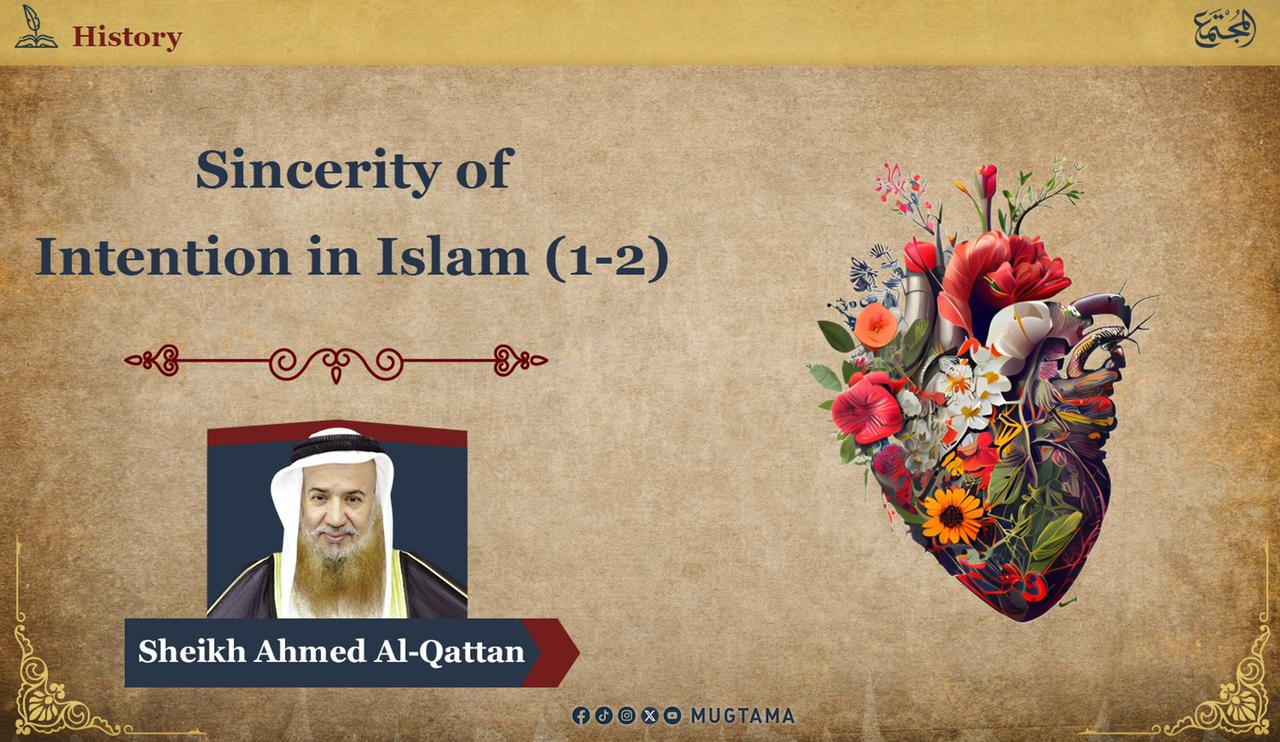
Sincerity of Intention in Islam (1-2)
This talk
is about the most dangerous issue—an issue where you may come on the Day of Judgement
with half a date that stands like Mount Uhud, forming a barrier between you
face and the Fire, or you may come with prayer, fasting, zakah, Hajj, `Umrah,
and remembrance of Allah (dhikr)—yet find not even a single atom of good deed
on your scale.
To Those with Devious Intentions
Allah the
Exalted Addresses, in His Noble Book, those with corrupted intentions and who
associated others with Him.
He Says, {They were only commanded to worship Allah ˹alone˺ with sincere devotion.} [Al-Bayyinah 98:5]
This
includes the Jews, the Christians, and the followers of all religions that
Allah Revealed and were later distorted, whose hearts deviated. And many from
the Ummah of Muhammad (peace be upon him)
have been afflicted with this hidden disease and subtle plague: the illness of showing off (riya’)
and minor shirk, which flows through the sons of Adam like blood—erasing
intention, killing sincerity, and nullifying deeds. A person comes on the Day
of Resurrection and finds no good deeds stored for him with Allah.
Deeds Are Judged by Intentions
The
beloved Prophet (peace be upon him)
laid down the foundation of this grave matter with a magnificent hadith—the
hadith by which books of fiqh begin and open. It is narrated by `Umar Ibn Al-Khattab
(may Allah be pleased with him) that the Prophet (peace be upon him) said: “Actions are
(judged) by motives (niyyah), so each man will have what he intended. Thus, he
whose migration (hijrah) was to Allah and His Messenger, his migration is to
Allah and His Messenger; but he whose migration was for some worldly thing he
might gain, or for a wife he might marry, his migration is to that for which he
migrated.” (Narrated by Al-Bukhari and Muslim)
Imam Ash-Shafi`i
said: This hadith constitutes one-third of knowledge and is included into
seventy chapters of fiqh.
The
Prophet (peace
be upon him) also said regarding this matter: “In Medina there are people who did not fail to be with us
whatever valley we crossed, and tread on a territory unnerving the disbelievers,
and whatever we spent (of our goods), and whatever hunger we suffered. They
have not failed to share your reward while they are still in Medina, being kept
back by a valid excuse.”
And Jabir
(may Allah be pleased with him) narrated that the Prophet (peace be
upon him) said: “You
have left behind in Medina men who, every time you crossed a valley or
travelled a road, they shared with you in the reward. They have been detained
by illness.” (Narrated by Muslim, and by Al-Bukhari from the hadith
of Anas.)
These
people shared purely because of their good intention.
When Intention Leads to Punishment
The
Prophet (peace
be upon him) said regarding intention, as narrated
by Abu Bakrah Nufay` Ibn Al-Harith Ath-Thaqafi (may Allah be pleased with him):
“If two Muslims meet each other with their
swords then (both) the killer and the killed one are in the (Hell) Fire.” I
said, “O Allah's Messenger (peace be upon him)! It is alright for the killer, but
what about the killed one?” He said, “The killed one was eager to kill his
opponent.” (Narrated by Al-Bukhari and Muslim)
He intended
to kill his Muslim brother—so even though he was the one killed, he is cast
into the Fire because of his intention. This is among the gravest matters, yet
people are heedless of it.
Actions
are judged by intentions. This is the decisive statement—the dividing line
between truth and falsehood.
The
weight of faith or the dominance of Satan is not determined by appearance,
height, width, status, lineage, or ancestry—but solely by intention. All praise
is due to Allah who enabled Muhammad (peace be upon him) to utter this magnificent hadith.
Intention: The Decisive Criterion
Between Truth and Falsehood
Based on
this hadith, we highlight several important reflections on its meanings:
Reflection One: Sincerity Is the Core of
Worship
Allah the
Exalted Says, {Say, “I am commanded to worship
Allah, being sincerely devoted to Him ˹alone˺.} [Az-Zumar 39:11]
Allah Urges
us toward sincerity and
calls us to it. It is the slogan of every worshipper when beginning prayer: {Say, “Surely my prayer, my sacrifice, my life, and my
death are all for Allah—Lord of all worlds. He has no partner. So I am
commanded, and so I am the first to submit.”} [Al-An`am 6:162–163] Every
Muslim says this while standing before Allah in prayer.
Reflection Two: Allah Looks at Hearts,
Not Appearances
The
Prophet (peace
be upon him) said: “Allah
does not look at your figures, nor at your attire but He looks at your hearts
and accomplishments.” (Narrated
by Muslim)
If the
judgment were based on appearances and bodies, we would leave the mosque
empty-handed—paupers standing at the door of Allah. And Allah is sufficient as
the Bestower and Helper. Whoever has Allah with him is rich through Allah;
whoever has Allah against him is poor before Allah—even if all mankind and jinn
stand with him.
Reflection Three: Equal Reward Through
Intention Alone
The
Prophet (peace
be upon him) said: “The
world is only for four persons: A man to whom Allah gives wealth and knowledge—he
knows that Allah has a right in it and that kinship has a right—this man is in
the highest ranks. And a man to whom Allah gives knowledge, but he does not
give him wealth, so he says: “If I had been given (wealth) like this one, I
would have done what (the first man) did.” He is equal to him in reward because
of his intention.”
You come
on the Day of Judgement with this firm intention, and Allah Grants you rewards
equal to the wealth of the people of the earth. Leave the people of fortunes
and treasures—they are gathering for their punishment on the Day of Judgement.
“And a man to whom Allah gives wealth but does not give knowledge—he
does not see that Allah has a right in it nor that kinship has a right—this one
is in the worst rank. And a fourth miserable man whom Allah has given neither
wealth nor knowledge, and he says: ‘If I had wealth like so-and-so, I would act
as he does.’ He is equal to him in sin because of his intention.”
He wished
for the wealth of the corrupt in order to commit corruption and sins. He comes
on the Day of Resurrection with the poverty of this world and the poverty and
punishment of the Hereafter.
Reflection Four: When Deeds Turn to Dust
From the
hadith of Thawban (may Allah be pleased with him), the Prophet (peace be
upon him) said: “I
certainly know people of my nation who will come on the Day of Resurrection
with good deeds like the mountains of Tihamah, but Allah will make them like
scattered dust.” Thawban said: “O Messenger of Allah, describe them to us and
tell us more, so that we will not become of them unknowingly.” He said: “They
are your brothers and from your race, worshipping at night as you do, but they
will be people who, when they are alone, transgress the sacred limits of
Allah.” (Narrated by Ibn Majah)
They will
have many good deeds like white mountains, but when they stretch out their
hands to take them, they find nothing. The guards will drive them to the Fire.
They made Allah the least of those watching them when they were alone with sin.
You May Also Read:
- Could the Corrupt Be Well-Intentioned?
- 4 Ways to Protect Yourself from Shaytan (Satan) in Islam
- Book Review: “Diseases of the Hearts” By Sheikh Abdul Rahman Bin Muhammad Al-Masri
-------------------------------------------------------------
Taken from Sheikh Ahmed Al-Qattan’s Website