



The Occupation's Plan for Al-Aqsa Mosque After Ramadan
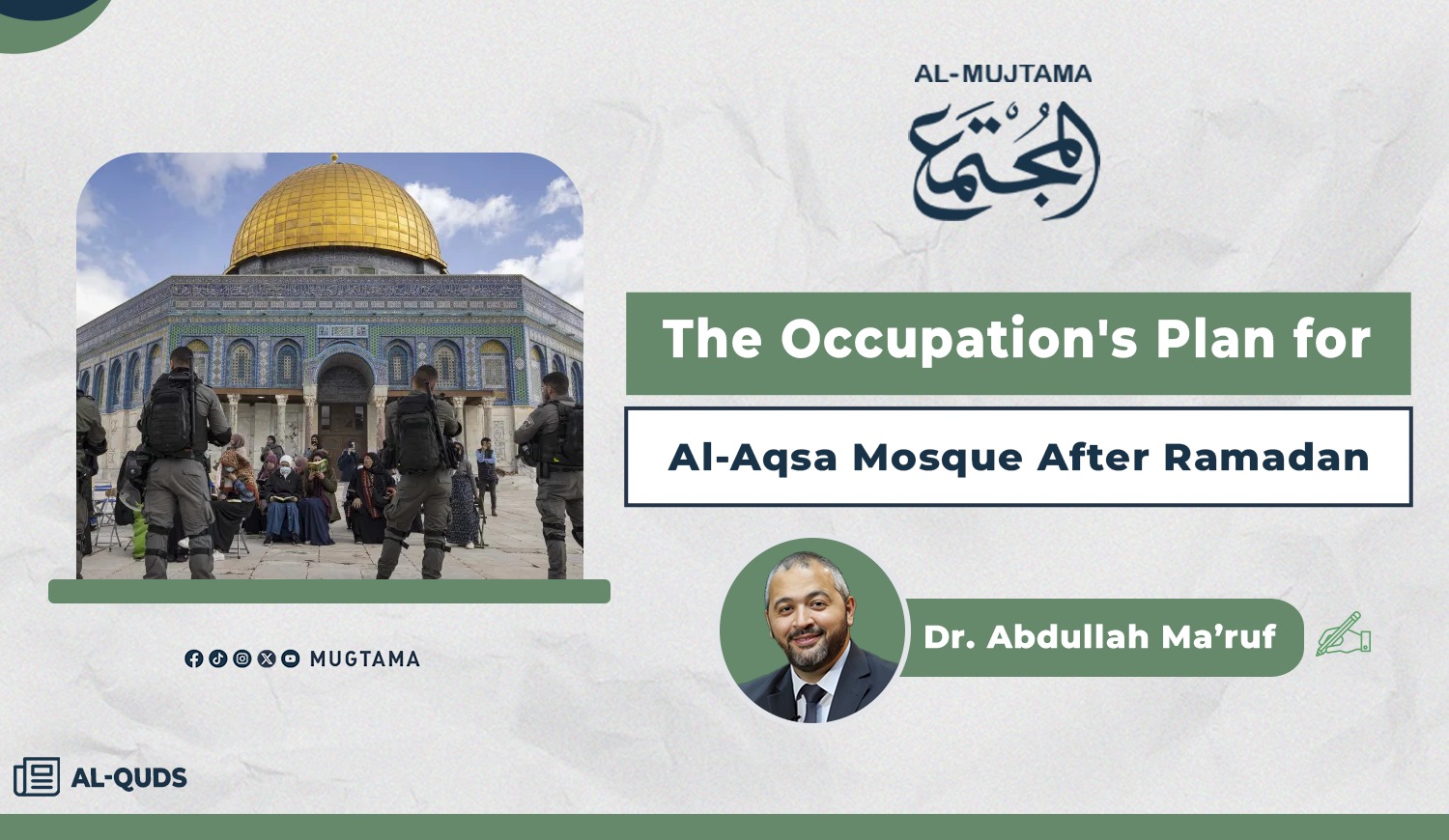
The closure of the blessed Al-Aqsa Mosque
during the last ten days of Ramadan—ordered by the occupation authorities for
the first time since 1967—has captured the attention of the Arab and Islamic
worlds. Many realized, albeit late, the gravity of what transpired in the
mosque during those nights, especially as the Islamic world awoke to the
harrowing sight of Al-Aqsa completely deserted on the final Friday of Ramadan
('The Orphan Friday'). This day typically draws over 300,000 worshippers, while
the 27th night usually sees more than 150,000 in spiritual retreat (I'tikaf).
This was compounded by scenes of suppression and the use of stun grenades
outside the Old City walls, as occupation forces pursued worshippers to
minimize their numbers as much as possible.
In addition to this, the Islamic Waqf
Department is facing unprecedented pressure and restrictions that have left it
nearly paralyzed and unable to staff the mosque. The occupation has capped the
number of employees permitted entry to a mere twenty-five, contingent upon its
prior approval. A grave report by Middle East Eye revealed that when the
Waqf’s Manuscripts Department sought to bring in just one additional employee,
the occupation police threatened to immediately open the mosque to settler
incursions should the department exceed the government-mandated quota by even a
single person.
All these events point to the fact that
Al-Aqsa Mosque is now on the threshold of a serious attempt to decide its fate,
and that the occurrences during the month of Ramadan were merely a prelude to
this process.
Why do we say this?
Several facts point in a single direction:
the occupation's intention to definitively settle the issue of Al-Aqsa Mosque
this year. Since late 2025, the occupation has initiated a series of measures
all leading toward this objective. This includes, for instance, the appointment
of Avshalom Peled—a member of the Religious Zionism movement—as the Jerusalem
District Police Commander. This extremist arrived with a specific agenda
regarding the blessed Al-Aqsa Mosque; his appointment followed a dispute between
Itamar Ben-Gvir and the former Jerusalem District Police Commander, Amir
Arzani, who had refused to allow settlers to bring tables, chairs, and
equipment into Al-Aqsa Mosque for fear of sparking unrest.
Furthermore,
the dispute at the beginning of Ramadan between the occupation police and the
Head of the Jerusalem Waqf Council—stemming from the police 'summoning' the
latter and his refusal to appear—served as a clear indicator of the
occupation’s attempt to reshuffle the status quo at Al-Aqsa through this
provocative move. In retaliation for his refusal, the occupation banned the
installation of sunshades within Al-Aqsa, prohibited Iftars and Suhoor for the
guards, and prevented the preparation of the mosque's medical clinic. In other
words, the occupation stripped the holy month of Ramadan of any special
sanctity for the first time in history. This culminated in the full and strict
closure of Al-Aqsa Mosque under the pretext of the ongoing regional war, occurring
during the most significant days of the year for Muslims: the last ten days of
Ramadan. The occupation also explicitly announced that the closure would extend
to banning Eid prayers at Al-Aqsa Mosque as well.
The
implementation of peak restrictions and tightening measures against Muslims
during Ramadan—the occupation’s most challenging period, particularly the last
ten days due to the high density of Muslims in Jerusalem—serves as a field
test. It evaluates the occupation police’s ability to impose their will during
times that are typically considered easier and lighter than the month of
Ramadan.
“Hebrew Passover”: The Upcoming Threat and the “Sacrificial
Slaughter” Plan
Since the occupation has succeeded in fully
imposing its will and containing the Palestinian reaction during the peak
period it fears most, it will undoubtedly be capable of doing so during other
times when the Islamic presence at Al-Aqsa is not at its height. This is an
opportunity that the occupation will surely seek to seize and exploit to the
fullest extent, particularly as it nears a golden opportunity for settler
presence within Al-Aqsa: the Hebrew Passover, which falls between April 2 and
9—just ten days after the end of Eid al-Fitr.
The
Hebrew Passover is considered central to the rituals that extremist 'Temple
Groups' seek to perform as part of their vision to establish the alleged Temple
spiritually within Al-Aqsa Mosque before its physical establishment. This is
because it involves the most significant ritual within the Temple: the
slaughtering of animal sacrifices.
For over
ten years, the 'Temple Groups' have attempted to perform this ritual inside the
mosque without success. Consequently, they resorted to conducting annual
simulations of the slaughter and burning of sacrifices around Al-Aqsa Mosque,
and sometimes directly in front of its walls. However, a dangerous development
occurred last year that will embolden them to pursue their goals this year:
some members actually succeeded in bringing animal sacrifices (alive in two
instances and already slaughtered in one) into the grounds of Al-Aqsa Mosque.
They were stopped by Muslims before they could carry out their plan upon
reaching their target area—the Dome of the Chain, adjacent to the Noble Dome of
the Rock—which they believe to be the site of the 'altar' in the alleged
Temple.
The
success of these individuals in reaching the interior of Al-Aqsa Mosque last
year, combined with Avshalom Peled heading the Jerusalem District Police—the
body primarily responsible for Al-Aqsa for the occupation this year—makes it
logical to conclude that this year will likely witness a very serious attempt
to slaughter the sacrifice inside Al-Aqsa Mosque during the upcoming Passover,
perhaps even with the full support of the occupation police.
The “Reopening” Deception: Entrenching Temporal and Spatial
Division
Accordingly,
we do not rule out that the occupation will announce the reopening of the
blessed Al-Aqsa Mosque just before the start of the Hebrew
Passover—specifically at the end of this March or the very beginning of next
April, and perhaps at the start of that week. This reopening would be for both
Muslims and settlers together, as the occupation now treats both parties as
equals and refuses to open it solely for Muslims, even if the war continues
during that period. By doing so, the occupation will have paved the way for
settlers to perform their sacrificial rituals during the Hebrew Passover.
Consequently, we say this to preempt any claims from any party: the
occupation's announcement to reopen Al-Aqsa Mosque cannot be regarded as an
achievement, as it was closed by the occupation’s decree and will be reopened
by the occupation’s decree as well, not due to pressure from any official in
the Arab or Islamic world, unfortunately.
Obstacles to the Plan: Expansion of the War or Internal Upheaval
Perhaps
the possibility that might complicate this mission for the occupation is an
escalation of the war to a degree that exceeds the occupation's ability to bear
the cost of opening Al-Aqsa Mosque and moving in such a decisive,
confrontational direction. The second possibility that could make the
occupation’s task difficult is a security-related event on the home front, such
as widespread popular unrest in Jerusalem and the interior in anticipation of
such an operation. This would strike the occupation at its most prominent
vulnerability during the current war: its fragile home front. It is well known
that states and entities become internally vulnerable during major wars and
conflicts; thus, any significant disturbance on the ground in Jerusalem and the
interior would have a profound impact, forcing the occupation to seek the
postponement of any internal explosion in favor of focusing on its external
crisis.
Popular Deterrence: The Only Option to Protect Al-Aqsa
Ultimately,
we are heading toward difficult and decisive days for the blessed Al-Aqsa
Mosque. There is no way to protect it except by restoring a state of popular
deterrence, so that the occupation and its apparatus understand practically—not
just theoretically—that any encroachment on Al-Aqsa Mosque will carry a very
high price that the occupation simply cannot bear.
Otherwise,
we are essentially risking the total loss of Al-Aqsa Mosque—God forbid. Can our
Ummah truly endure such a catastrophe?
You may
also like: