






The West Bank: Between Raids and Daily Life
In the
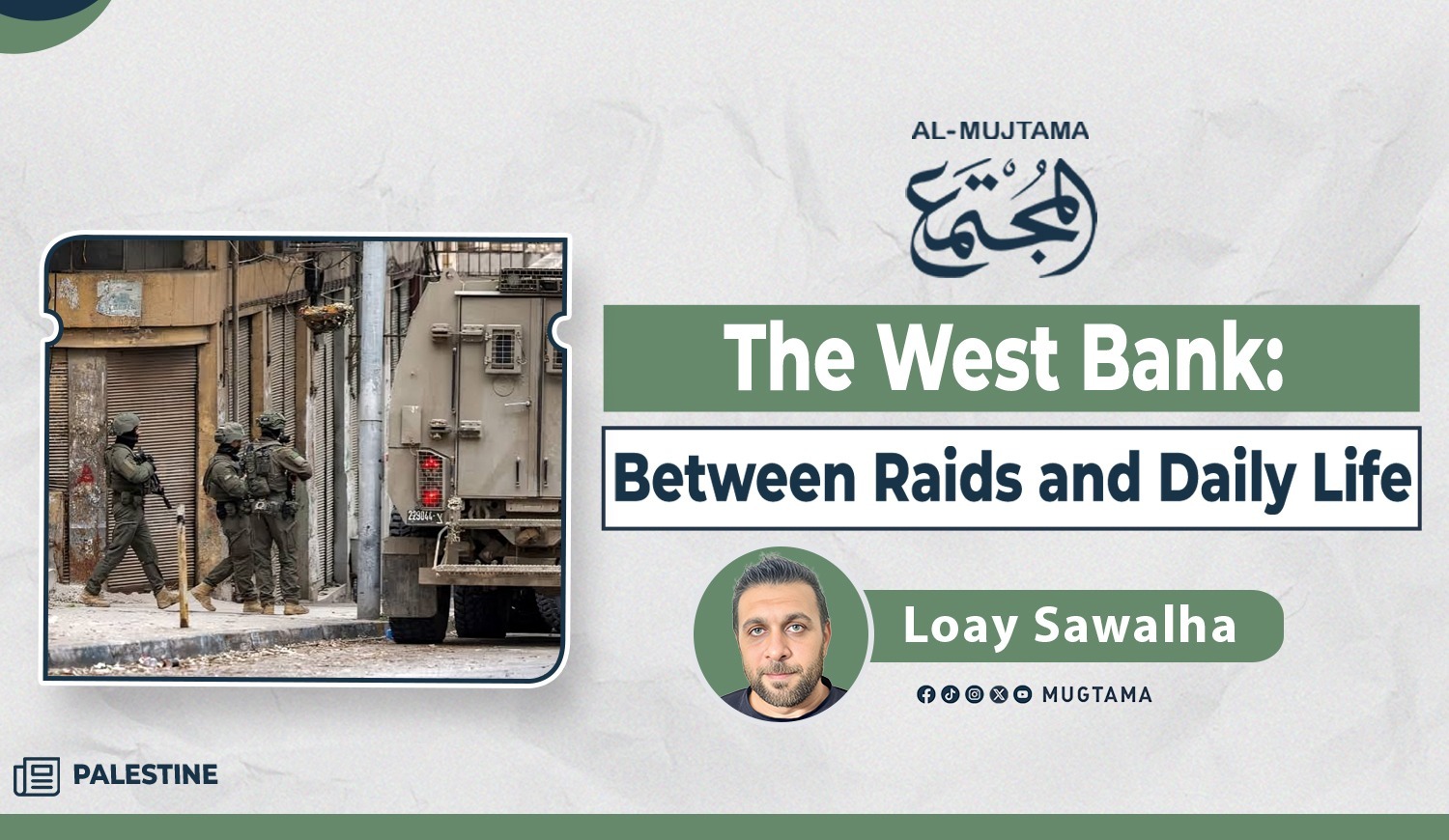
West Bank, Palestinian families do not live their days like anyone else. Here,
time is unstable, and space is vulnerable to intrusion at any moment. Daily
life moves to the rhythm of anxiety; danger is no longer an exception, as the
ordinary itself has become heavy with threat. Raids are no longer 'breaking
news' but a fixture of the landscape—intertwining with work, education, and
family, and redefining the very meaning of life under occupation.
Exposed Spaces
The story
often begins before dawn. Residential neighborhoods—meant to be
sanctuaries—transform into exposed spaces. Occupation forces enter without
warning, surrounding homes and imposing a forced reality for hours. As one
resident recalls: 'We don’t sleep deeply anymore. Any night sound could signal
a raid; our children are awake before we even realize what’s happening.
The Impact of Raids
The
impact of a raid doesn't end when the soldiers leave; it lingers. Broken doors
can be mended, but the sense of security never truly returns. What was once a
private sanctuary becomes a fragile space, vulnerable to intrusion at any
moment. This leaves behind deep psychological scars, particularly for children
and the elderly.
Everyday Tools
As the
night hours fade, people try to reclaim the rhythm of their day. In the West
Bank, mornings don't start with a clear plan, but with 'attempts'—to reach
work, to open a shop, to cross a checkpoint. Both fixed and mobile, these
checkpoints have become daily tools for the forced reorganization of
Palestinian life. As one worker puts it: 'I leave before sunrise. I might
arrive, I might be stuck for hours, or I might be turned back. No one has an
answer.
Constant Disruption
This
reality has taken a direct toll on the economy through constant business
disruptions, daily losses, and relentless pressure on low-income families.
Despite the odds, many insist on trying every day; for them, stopping work
means a rapid descent into poverty. This appears to be part of a broader policy
of economic strangulation.
Unfamiliar Scene
In
parallel, children head to school amidst a scene unfamiliar to any normal
childhood. Some navigate checkpoints, others witness raids on their way, and
some are forced back home before they even arrive. Inside the classrooms, the
outside world is never absent. A veteran teacher from the northern West Bank
notes: 'We see a clear shift in our students' behavior; anxiety is
ever-present, and their questions are far bigger than their years.
The Educational Process
Education
in the West Bank is no longer a stable process; it is a daily struggle to
maintain a bare minimum of continuity. Frequent interruptions, forced absences,
and psychological stress are all factors weighing heavily on academic
achievement. Despite this, teachers and students persist, viewing the
educational process as a way of clinging to the future.
Behind
closed doors, families bear a double burden. Women, in particular, face the
daunting task of containing fear, safeguarding their children’s psychological
well-being, and mending their lives after every raid. As one mother reflects:
'We try to appear calm for our children; we hide our fear because if they sense
it, they will collapse.
Anxiety
does not leave the home easily; it manifests as insomnia, tension, and a
perpetual state of alert for the next emergency. Even after a raid ends, it
lingers in memory, casting a shadow over family relationships and the overall
sense of stability.
A Deferred Idea
In
villages and camps alike, the testimonies are strikingly similar; geography
does not change the essence of the experience. One resident captures the scene:
'We live day by day; tomorrow is a deferred idea.' Another adds: 'We don't ask
for much—just for the night to pass in peace.' These accounts, shared
anonymously for fear of reprisal, reveal that these are not isolated incidents.
Rather, they form a systematic reality imposed on an entire community,
targeting its very sense of security and stability.
Full Coverage
Politically,
this reality coincides with a clear escalation in Israeli government policies,
which provide full cover for raids and arrests. The West Bank is treated as an
open theater for security operations, with little to no regard for the profound
human impact.
In the
absence of effective international pressure, Palestinian civilians face this
reality alone, virtually unprotected. Yet, life does not cease. After every
raid, schools reopen, homes are mended, and people return to work. This
continuity is not an 'adaptation' to injustice, but a rejection of it through a
tenacious grip on life. Resilience here is not a slogan; it is practiced in the
daily grind—in the pursuit of education, the protection of jobs, and shielding
children from despair. Between the raid and the routine, Palestinians face one
choice every morning: to continue. Not for a lack of fear, but because they
know that existing, in itself, is an act of resistance.
You may
also like:
Israel Escalates Al-Aqsa Restrictions to Assert Control Before Ramadan
Im Tirtzu: Campus Watchdog or Ideological Enforcer?
Field
Notes & Authenticity:
1.
Direct
field testimonies from Palestinian citizens in cities, villages, and camps
across the northern and central West Bank (Names withheld for security
reasons).
2.
Interviews
with educators and employees in the educational and public service sectors
within the West Bank.
3.
On-the-ground
observations and continuous field coverage by the journalist.
4.
Human
rights reports issued by Palestinian and international organizations monitoring
occupation violations in the West Bank.