









History of Kuwait
Three Walls Bearing Witness to Kuwait’s Epics of Resilience

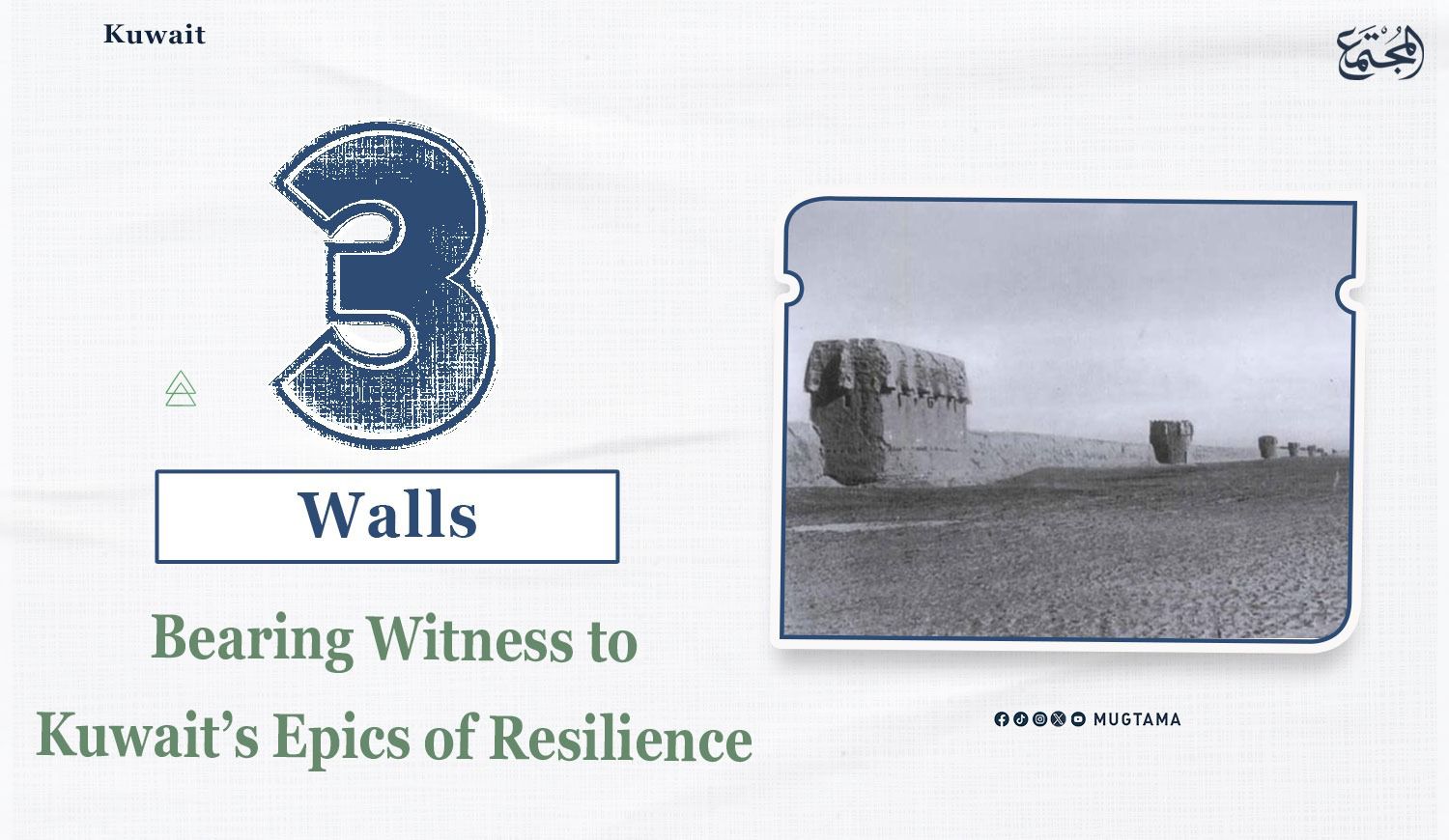
For more than two centuries, Kuwait’s walls were never mere mud structures; they were national epics embodying values of popular solidarity and refusal to bow before ambitions. The chapters of this epic began in the eighteenth century, as those walls transformed from defensive fortifications into historical icons encapsulating the story of a people who built their security with their own hands.
The First Wall: Cornerstone and Sovereignty (1760)
After the Kuwait
area was settled and its population increased, it became exposed to
surrounding dangers. This prompted Kuwaitis, under the leadership of Sheikh
Abdullah bin Sabah, to consider a means of protecting their city.
In December 1789, the first
wall was built as a declaration of sovereignty. It extended nearly a mile,
forming a semicircular arc that protected the city’s beating heart. It
contained five gates (darwazas), serving as arteries regulating the
movement of caravans and security.
The Second Wall: Reinforcing Fortifications and Unity (1814)
The first
wall did not last long. The second wall came
during the era of Sheikh Jaber bin Abdullah Al‑Sabah, encompassing a wider area
and extending 2,300 meters. In 1845, the spirit of collective responsibility
was manifested when the wall was restored to confront external threats.
This wall was distinguished by seven
gates and the emergence of Al‑Mutabba, which later became the name of
one of Kuwait’s oldest neighborhoods, bearing witness to the people’s
resilience and their ability to harness challenges for their security.
The Third Wall: The Great Epic of Loyalty (1920)
The third
wall remains a symbol of the “national miracle.” After the Battle of
Hamd, the entire Kuwaiti people rose in an inspiring epic to complete a wall
five miles long in only 60 days.
During the era of Sheikh Salem Al‑Mubarak
Al‑Sabah, Ramadan nights turned into a massive workshop under the light of
primitive lamps, as men sang the ‘Ardha with enthusiasm while caravans
carried mud and water.
The wall included five majestic gates
and 26 watchtowers (ghawla), becoming the impregnable fortress that
never ceased to protect its people.
------------
Read the article in Arabic