


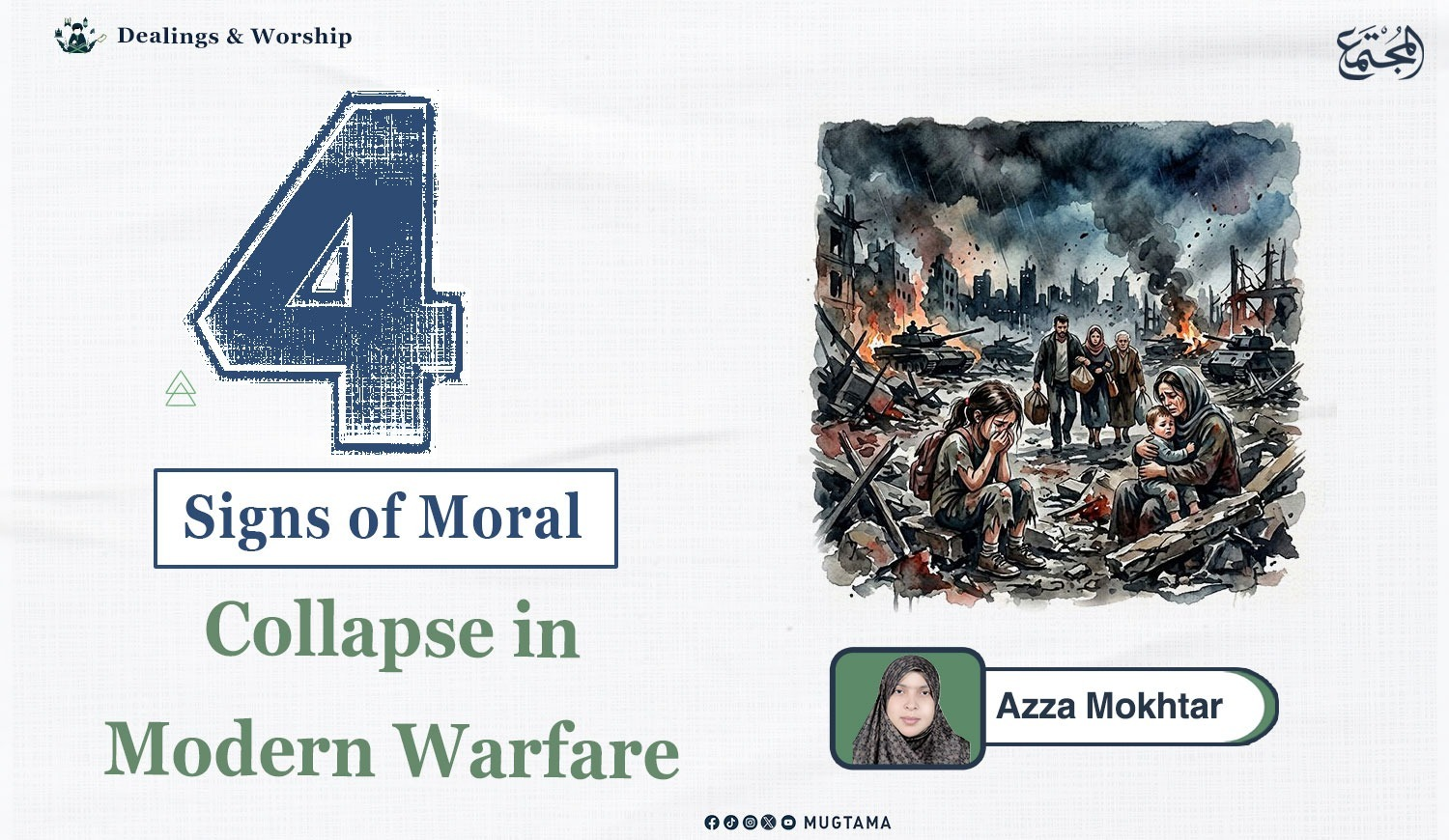
4 Signs of Moral Collapse in Modern Warfare
The ethics of warfare
in the modern age have changed to the point that they have completely lost
their human morality. Destruction has become beyond human imagination on both
sides, and one can no longer distinguish between the defeated and the
victorious. In these wars, everyone is defeated; everyone loses—people,
property, and possessions alike. All pay a heavy price due to the massive
losses caused by modern weapons of destruction.
Shameful Manifestations of Moral Collapse in Wars
There are
shameful manifestations of moral collapse resulting from the outbreak of such
wars. In the following lines, we highlight some of them:
1. Targeting Civilians as a
War Strategy
Modern warfare has
adopted, among its strategies, the targeting of those who are not involved in
bearing arms and are incapable of doing so—intensifying human and material
losses for the opposing side. This may also stem from an inability to achieve
victories on the battlefield, leading to the deliberate killing of as many
civilians as possible, under the illusion that this constitutes a form of
victory, when in reality, only the truly defeated resort to such actions.
Such acts
have been explicitly and strongly prohibited in Islamic texts, and the
practices of the Prophet (peace and blessings be upon him) during his battles
against disbelievers confirm this. At the height of his victory during the
Conquest of Mecca, his command was to preserve lives. He said: “Who lays down arms will be safe, and who locks his door will
be safe.” (Narrated by Muslim)
He also said: “Do not kill offspring; every soul
is born with a true faith of Islsm (fitrah).” (Narrated by An-Nasa’i)
The term
“civilians” is relatively modern; in Islamic law, it appears in other
expressions such as “non-combatants.” Al-Mawardi described them as: “those
weakened by old age or incapacitated by disability…” (1). Others
have defined them as: “those who have laid down their arms and returned to
their work, and anyone who maintains actual neutrality from aiding the enemy,
such as foreign military attachés, journalists, and religious figures
accompanying armed forces. These are not considered combatants whose blood may
be lawfully shed” (2).
Thus, the
ethics of war in Islam become clear: the protection of civilians from
killing, regardless of the intensity of the battle or the strength of the
weapons used.
2. Justifying Killing
Through Media Narratives
Among the
worst manifestations of moral collapse in modern wars is the use of media to distort and manipulate facts in order to justify the killing of innocent
people—those who are not even related to the objectives of war. Regardless of
such justifications, they do not protect their perpetrators from the wrath of
Allah, even if these narratives find acceptance among people. Children, women,
the weak, the elderly, religious figures, and the resources of the earth—all
that benefits humanity—are not targets of war to be struck by killing machines.
“Islam
has prohibited holding one person accountable for the sin of another and
established that no soul bears the burden of another. Allah says,
{No one will reap except what they sow. No soul
burdened with sin will bear the burden of another. Then to your Lord is your
return, and He will inform you of your differences.} [Al-An`am 6:164] When
war becomes a reality between Muslims and others, Islam instructs that
civilians and all those seeking lawful livelihood be spared from the evils and
calamities of war, so long as they are neither combatants nor supporters of
combatants. Allah says, {Fight in the cause of
Allah ˹only˺ against those who wage war against you,
but do not exceed the limits.} [Al-Baqarah 2:190]” (3)
“Allah
also says, {Fight in the cause of Allah ˹only˺ against those who wage war against you,
but do not exceed the limits.} [Al-Baqarah 2:190] Ibn Jarir At-Tabari commented in his tafsir: The transgression that Allah has forbidden is the
killing of women and children.” (4)
Ibn `Umar
(may Allah be pleased with them both) reported: “A
woman was found killed in one of the battles of the Messenger of Allah (peace
be upon him), so the Messenger of Allah forbade the killing of women and
children.” (Narrated by Al-Bukhari and Muslim)
Islam
strongly emphasized the gravity of killing and warned against it. Allah says, {That is why We ordained for the Children of Israel that
whoever takes a life—unless as a punishment for murder or mischief in the
land—it will be as if they killed all of humanity.} [Al-Ma’idah 5:32]
The
Prophet (peace be upon him) said: “If the
inhabitants of heaven and earth were to share in [shedding] the blood of a
believer, God would overturn them in hell.” (Narrated by At-Tirmidhi)
Thus, justifying the killing of innocents is itself participation in the act of
killing.
3. The Deliberate
Destruction of Civil Infrastructure
The destruction of infrastructure in modern wars is not a secondary issue addressed
incidentally in Islamic discussions on the ethics of war. Rather, it is a moral
and doctrinal issue that touches upon human belief and one’s perception of
their role and limits on earth.
In
prohibiting corruption on
earth, the Quran establishes a framework for dealing with the resources that
Allah created for human benefit. Allah says, {Do
not spread corruption in the land after it has been set in order.} [Al-A`raf 7:56]
The Quran also links corruption with destruction: {And when they leave ˹you˺, they strive throughout the land to
spread mischief in it and destroy crops and cattle.} [Al-Baqarah 2:205]
In terms
of protecting non-combatants and ensuring the safety of their property, the
Prophet (peace be upon him) advised army commanders: “Do not kill a decrepit old man, or an infant, or a woman, and do not
cut down palm trees or burn them.” (Narrated
by Malik in Al-Muwatta’)
Regarding
the prohibition of treachery and unlawful destruction, Allah says, {Do not let the hatred of a people lead you to injustice.
Be just! That is closer to righteousness.} [Al-Ma’idah 5:8]
Thus,
hostility does not justify crossing moral boundaries, and justice is not
optional—it is an obligation and a divine duty in Islam.
4. Collective Punishment
and Revenge Warfare
Unlike
earlier wars that
revolved around direct confrontations, modern warfare has transformed into a
state of unjustified violence characterized by collective revenge against
entire societies. Communities exceed the limits of legitimate defense and
reproduce violence in a retaliatory form against all.
A state
may be attacked, yet instead of limiting its response to the aggressor, it
extends its retaliation to everyone around it without distinction. It resorts
to violence that harms the interests of innocent people and even targets them
without cause—moving from justice to vengeance against
those who bear no guilt. It is as though killing itself becomes the objective,
regardless of who is killed—even if he is a brother in religion and destiny.
This
revenge is often preceded by inflammatory and justificatory media discourse
that strips the oppressed party of its humanity and demonizes it to legitimize
its killing. This is further fueled by a history filled with grudges,
hostility, and wounded memory—transforming such memory into a reservoir of
revenge that can be invoked at any moment.
Media possesses the power to alter convictions by reinterpreting texts to justify violence and override religious values under the pressure of reality. Meanwhile, the foundational texts of Islam emphasize controlling anger, restraining emotions, fairness, and directing force only toward those who deserve it—not toward a fellow Muslim in a Muslim land. Allah says, {Do not let the hatred of a people lead you to injustice.} [Al-Ma’idah 5:8] and: {Those who restrain anger and pardon people..} [Ali `Imran 3:134]
This does
not mean that a Muslim should abandon his right to defend himself, his land, or
his honor. Rather, he must assert his will without allowing anger to drive him
into taking revenge on innocent others. This is the difference between justice,
which is governed by a moral balance, and revenge, which is driven by
uncontrolled emotion.
Modern
wars have become an unethical killing machine that bears no connection to true
humanity. It is upon humanity at large—and upon Muslims in particular—to deeply
reconsider their path in order to save humanity and restore it to the straight
course.
For Further Reading:
- Muslim Response to Global Threats
- Fiqh al Jihad Book By Dr. Yusuf al-Qaradawi Critical Questions Seeking Answers (3-3)
- Do Wars Reshape the Hierarchy of Values?
-------------------------------------------------------------
Footnotes:
- Al-Ahkam Al-Sultaniyyah Lil-Mawardi, p. 211
- Dr. Wahbah al-Zuhayli: Athar
al-Harb Fil-Fiqh Al-Islami, Dirasah Muqaranah, p. 503
- Marsad Al-Azhar, dated
13 November 2017
- Ibid.