








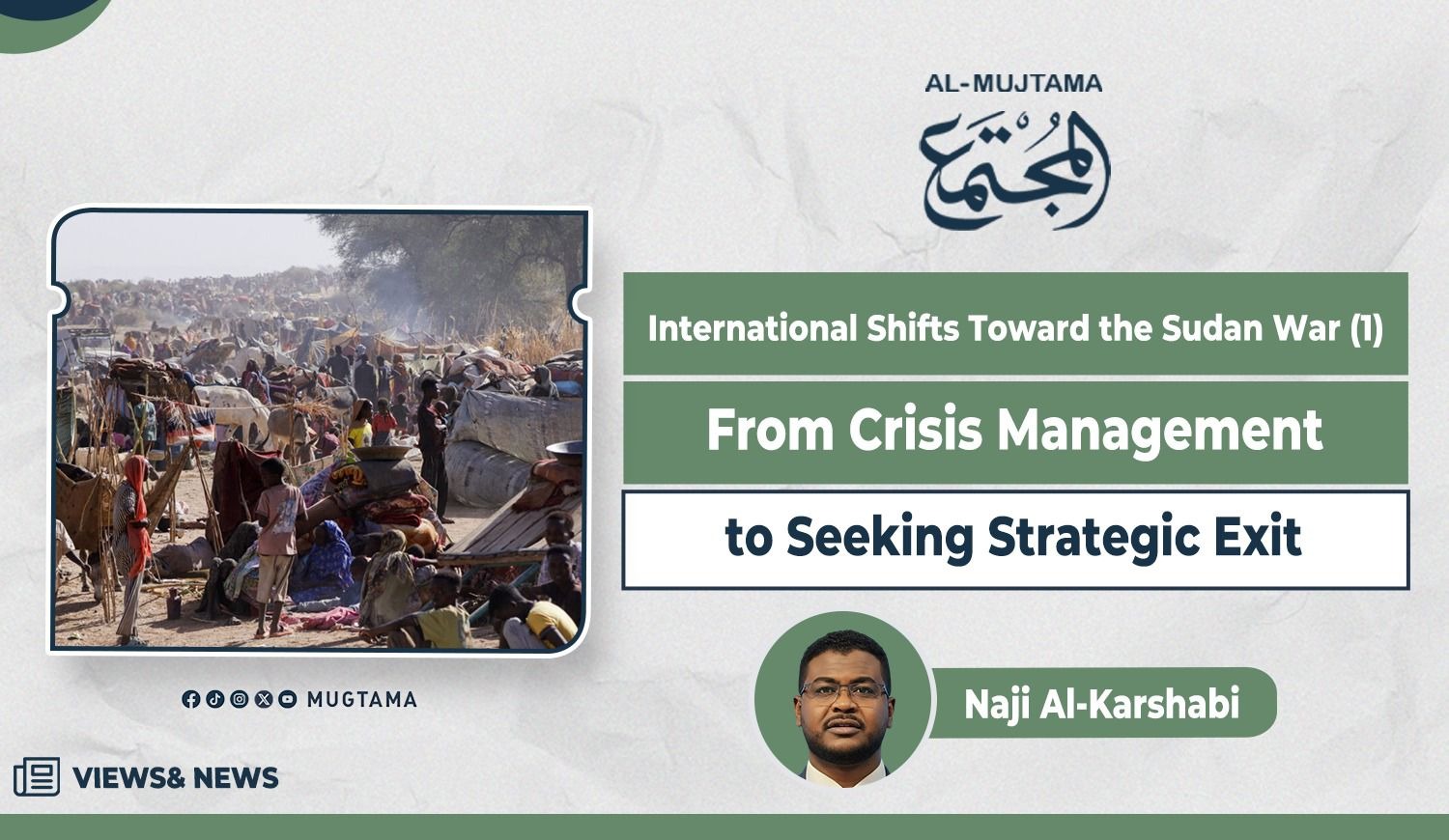
International Shifts Toward the Sudan War (1)
From Crisis Management to the Pursuit of a Strategic Exit

This ongoing series of articles is not
merely an attempt to analyze the war in Sudan through the lens of daily
developments or immediate reactions. Rather, it seeks to uncover the maneuvers
occurring behind international and regional scenes, exploring how and why the
global approach to this conflict has shifted—and what this evolution means for
the state and the future of Sudan.
Across these three installments, we
track the transition of the Sudanese file from the narrow scope of "crisis
management" to the pursuit of a "strategic exit." We dissect the
roles of key international actors, such as the United States, Saudi Arabia, and
Turkey—not as neutral mediators, but as powers actively realigning their
priorities based on regional security calculations and grand strategic
interests.
This is a sequential analysis where
each installment builds upon the last, gradually revealing how Sudan has
emerged as a central pivot in the geopolitical balance of the Red Sea and the
Horn of Africa. It explores the critical shift in global dynamics, illustrating
why the world can no longer afford to ignore the unfolding crisis.
Following the failed RSF coup attempt to seize
power—which received political backing from certain leaders within the FFC
coalition and was bolstered by regional military and financial support—Sudan
descended into a full-scale war in April 2023. Initially, the international
community framed the conflict as a localized military-political crisis,
believing it could be contained through standard condemnations, generic
ceasefire appeals, and the dispatch of urgent humanitarian aid.
This
pattern of engagement is nothing new. The international order is accustomed to
managing crises in fragile states through mitigation and containment, rather
than tackling the underlying drivers of conflict.
However,
the protracted nature of the war, its expanding geographic footprint, and its
evolution into one of the world’s most dire humanitarian catastrophes have
forced a gradual shift in the international perspective on Sudan.
The conflict is no longer viewed as a
mere internal struggle between local factions; rather, it has become a direct
threat to regional stability across the Red Sea and the Horn of Africa. It has
fueled arms and narcotics smuggling and flung the doors wide open for human
trafficking and irregular migration toward Europe.
This pivot in global perception
explains the changing diplomatic rhetoric, the realignment of priorities, and
the rise of regional actors that previously operated primarily behind the
scenes.
Why has the international stance
shifted?
The drivers of this international shift can be
distilled into three primary, interconnected factors:
1- A Protracted War with No End in Sight
Defying the initial projections of many
Western capitals, the war in Sudan proved to be neither short-lived nor
susceptible to a swift resolution—particularly following the Rapid Support
Forces’ (RSF) failure to seize power or achieve a decisive military
breakthrough.
Furthermore, all attempts at temporary
ceasefires collapsed, largely due to the RSF’s lack of commitment—most notably
regarding the Jeddah Declaration signed in May 2023 under U.S.-Saudi mediation.
That agreement explicitly mandated the RSF’s withdrawal from civilian
infrastructure, hospitals, and private residences that had been repurposed into
military outposts.
This state of perpetual attrition has
cultivated a climate of 'strategic uncertainty,' representing the worst-case
scenario for international policymakers.
2- The Worsening Humanitarian Catastrophe
Over time, the humanitarian crisis has
escalated far beyond the threshold of a conventional emergency, edging toward
the brink of genocide, systematic looting, and the deliberate impoverishment of
civilians, compounded by famine and total societal collapse.
With thousands dead and millions
displaced both internally and across borders, entire cities have been reduced
to rubble, and healthcare and education systems have faced a near-total
collapse. This staggering human cost is no longer ignorable—neither morally nor
politically—particularly as the specter of mass migration waves looms over
European shores.
3- Threatening International Strategic
Interests
Sudan is far from a peripheral player in
geopolitical calculations. Its strategic position on the Red Sea and the Horn
of Africa, its proximity to the Bab el-Mandeb Strait, and its shared borders
with seven nations make it a critical variable in the international security
equation. Consequently, any prolonged security breakdown would inevitably lead
to:
- Threats to international maritime navigation.
- The proliferation of illicit networks for arms,
narcotics, and human trafficking.
- A security vacuum exploitable by extremist groups
or rival global powers.
Collectively, these factors have
compelled major powers to realize that the policy of 'conflict management' is
no longer tenable; what is now required is a 'strategic exit' to avert a total collapse.
The U.S. Stance
The
United States has emerged as the most prominent actor on the international
stage regarding the Sudanese crisis, particularly through the Jeddah process,
which it co-sponsored alongside Saudi Arabia. However, the stalling of this
diplomatic track has exposed the limitations of American leverage in imposing
solutions upon a conflict defined by its profound complexity and deeply
intertwined interests.
The American position can be distilled
into the following key points:
1. Aversion to "Failed State" Scenarios:
Scarred by costly legacies in Libya and Somalia, Washington is determined to
prevent the emergence of another failed state in Africa.
2. Containment of Rival Influence: There is deep-seated
concern regarding the expansion of rival global powers into a burgeoning
strategic vacuum.
3. The Diminishing Returns of Delay: Washington
recognizes that a protracted conflict will render any future political
settlement exponentially more complex and costly to implement.
Consequently, the United States has
begun to pivot from the role of a direct manager to that of a coordinator and
delegator, granting greater latitude to its regional allies—led by Saudi Arabia
and Egypt—who possess tangible influence over the course of events.
This delegation does not signify an
American withdrawal; rather, it represents a strategic redistribution of roles.
Regional powers are expected to shoulder the burden of direct pressure, while
Washington retains its position as the political guarantor and international
backer.
Sudan in the New Regional Calculations
As a result of this shift, Sudan is no longer
viewed as a peripheral issue, but rather as a litmus test for the region's
capacity to manage its own crises. This explains the ascendancy of neighboring
states, the mounting rhetoric surrounding 'red lines,' and the staunch
rejection of any scenarios involving the partition or dismantling of Sudanese
state institutions.
The implicit international message has
become increasingly clear, summarized in the following pillars:
- No legitimacy for a reality imposed by force.
- No recognition of parallel entities.
- Zero tolerance for the dismantling of the
Sudanese state.
What Does This Mean for Sudan in
Practical Terms?
On the ground, this shift entails several
direct and indirect consequences, including:
1. Diminished Prospects for Recognition: There is a
significant reduction in the likelihood of international recognition for any
political or administrative arrangements established outside the formal state
framework.
2. Escalating Pressure over Violations: A noticeable
surge in political and media pressure is being directed at parties accused of
widespread atrocities, specifically the Rapid Support Forces (RSF).
3. The Securitization of Aid: Humanitarian assistance is
increasingly being conditioned upon the establishment of safe corridors,
security guarantees, and political understandings, rather than being left
vulnerable to the prevailing chaos
Potential Scenarios
In light of current shifts, three
primary scenarios can be envisioned:
- First: Long-term Containment: This scenario
entails an expanded humanitarian truce but falls short of a fundamental or
root resolution to the crisis.
- Second: Coordinated Pressure: This involves
unifying international and regional stances to actively propel a genuine
and substantive political track.
- Third: Persistent Instability: This scenario
assumes the failure of diplomatic efforts, leading to Sudan’s
transformation into a chronic and protracted crisis.
Conclusion: Current indicators suggest
that the second scenario is gaining the most traction. However, its success
remains strictly contingent upon the ability of international actors to address
the root causes of the Sudanese crisis—causes deeply rooted in regional and
international interference in Sudan's internal affairs, both before and after
the fall of the Bashir regime.
Key Conclusion
Recent international realignments
regarding the war in Sudan do not inherently signal an imminent resolution.
Instead, they underscore a critical reality: the world—and specifically
regional powers such as Saudi Arabia, Egypt, Turkey, and Qatar—is no longer
willing to stand by and witness the catastrophic collapse of the Sudanese
state. For these actors, the disintegration of Sudan carries stakes that are
far too high to ignore.
The transition of the Sudanese file
from the periphery of global concern to the core of regional and international
strategic calculations represents a historic opportunity; however, it remains
far from a guarantee. Ultimately, true transformation must originate from
within, leveraged through a precise reading of these shifting variables rather
than a passive reliance on miracles.
You may also like:
RSF’ Crimes Against Civilians in Sudan
From Rebellion to Genocide: The Full Story of What Is Happening in Sudan
Sudan: A War Without Borders... Heartbreaking Stories from the Heart of Hell
War in Sudan: Wounds of a Nation and a Call for Reform
______________________________