






Violence… An Alien Phenomenon in Kuwaiti Society
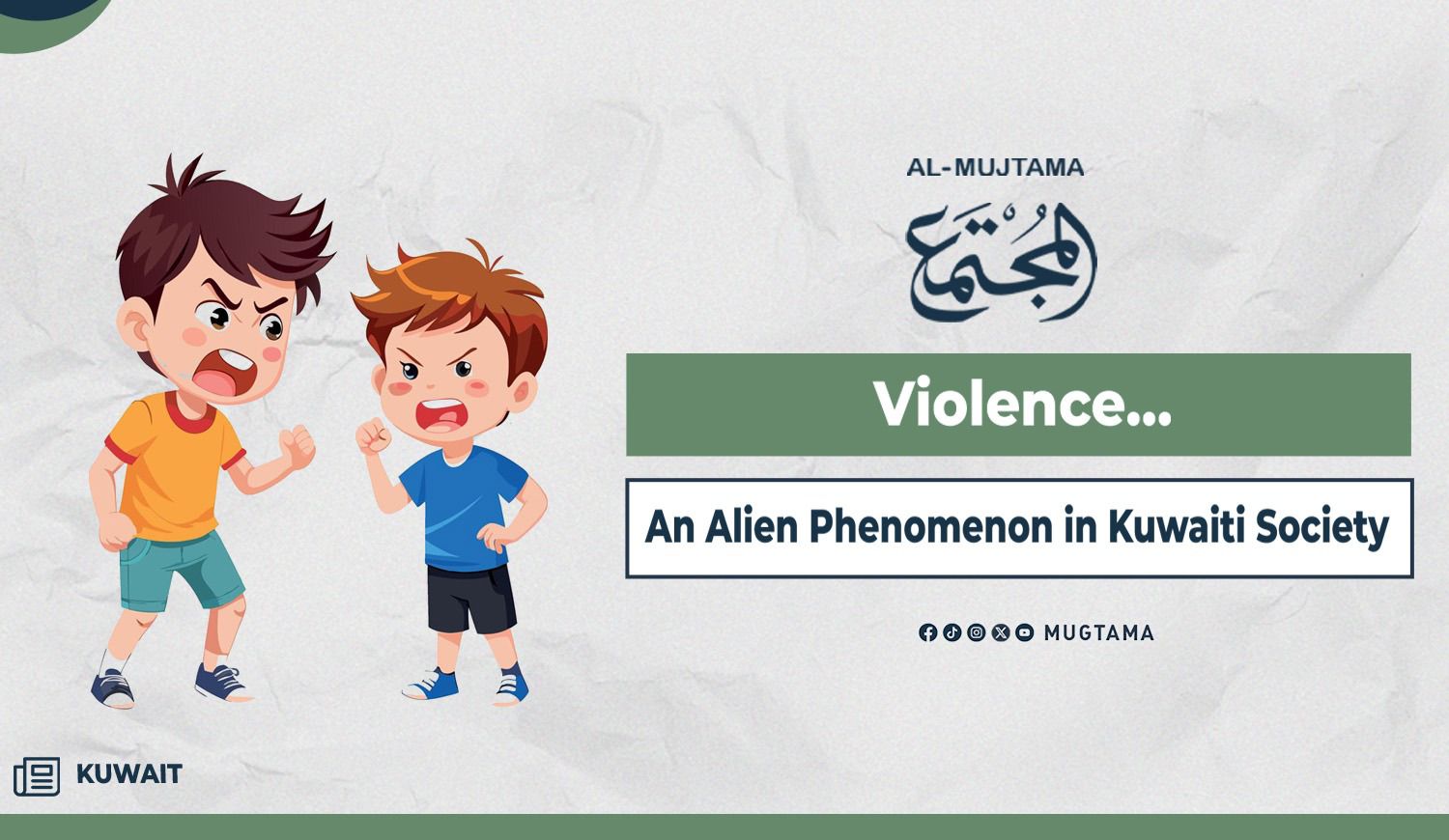
Throughout its long history, Kuwaiti society has never known violence as a deeply rooted social behavior. From its very beginnings, it was built upon cooperation, compassion, and solidarity, anchored in a moral and spiritual framework that made peace the essence of relations among its people.
Yet the rapid transformations witnessed across the world in
recent decades, accompanied by wide exposure to diverse cultures, have
introduced foreign patterns of conduct into our communities—foremost among them
the rising manifestations of violence in its various forms.
At its core, violence
reflects a profound rupture in the value system that governs human behavior.
And while Kuwait, by virtue of its faith, values, and social stability, has
long maintained low levels of this phenomenon, recent indicators call for
serious reflection. Today, violence appears in many guises: quarrels on the
streets, disputes in schools, excessive outbursts in sports arenas, and
tensions within households—all scenes alien to the authentic heritage upon
which generations were raised and of which Kuwaitis have always been proud.
Faith remains the foremost safeguard against slipping into
violence, reminding believers of God’s words: {And
the servants of the Most Merciful are those who walk upon the earth humbly, and
when the ignorant address them, they say ‘Peace’ }[Al-Furqan 25: 63], and of the Prophet’s
saying: “A Muslim is one from whose tongue
and hand other Muslims are safe” (reported
by Al-Bukhari). Such spiritual conduct calls for restraint of anger,
preservation of dignity, and preference for peace over conflict. Hence, religious
education in the home, school, and mosque has always been a cornerstone
in fortifying society against deviations that may weaken its cohesion.
While it is natural for societies to be influenced by the
changes of the age, the responsibility of confronting violence rests upon all:
the family, as the first factory of values; the school, which must teach
dialogue before instruction; the media, which shapes awareness; and the
religious and social institutions entrusted with reform and guidance.
With its honorable human legacy and cohesive social fabric,
Kuwait is capable of overcoming this phenomenon if efforts converge and
institutions adopt a national project to restore the values of tolerance,
self-restraint, and respect for the law.
Violence
is a phenomenon that can be contained and uprooted through
reason, awareness, and faith. As long as we hold fast to our will, identity,
and values, Kuwait will remain as we have always known it: a haven of security,
a land of mercy, and a society that refuses to harbor alien behaviors that
neither resemble it nor represent its true spirit.